Category: Articles

  • Why Omnichannel Marketing is No Longer Optional for Dealership Growth

    Why Omnichannel Marketing is No Longer Optional for Dealership Growth

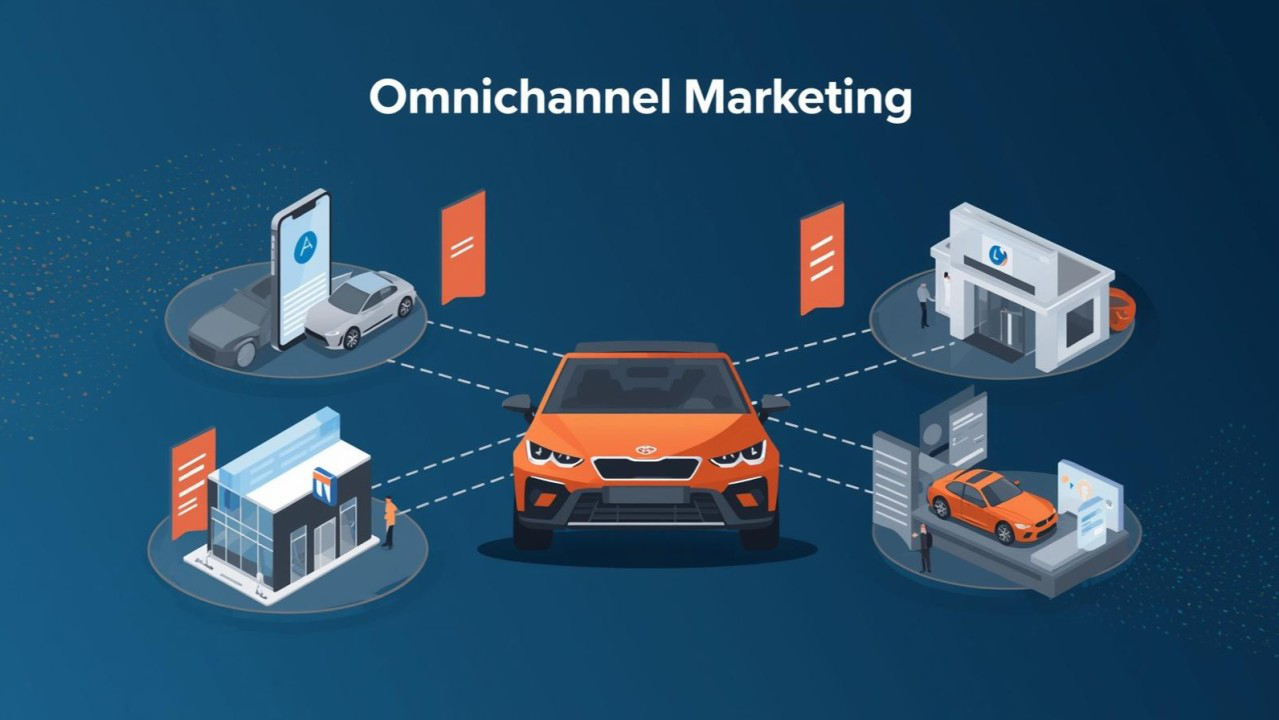
    For automotive retail leaders, the question is no longer whether omnichannel matters, it’s whether your organization is aligned to deliver it.

    Today’s car buyer does not move in a straight line. They move fluidly between search, social, OEM sites, third-party listings, and your showroom, often engaging with 15–20 touchpoints before making a decision.

    What they expect in return is simple: continuity. Not repetition. Not friction. Continuity.

    Single-channel strategies, whether overly reliant on paid search, third-party leads, or showroom traffic, are increasingly misaligned with how customers actually buy. Nearly half of buyers begin their journey online, yet very few complete it entirely there. Instead, they switch between digital and physical channels multiple times and expect their information, preferences, and pricing to carry across each interaction.

    This is where omnichannel becomes a competitive advantage not a marketing tactic, but an operating model.

    Recent industry data reinforces this shift. Cox Automotive’s 2025 Car Buyer Journey Study shows that dealers who deliver a seamless omnichannel experience are driving record-high customer satisfaction, fueled by integrated digital tools and more personalized interactions.  At the same time, omnichannel strategies are linked to stronger financial performance, with some studies showing up to 80% higher close rates and meaningful gains in gross profit.

    The implication for dealership executives is clear: consistency across channels is now table stakes.

    Customers expect:

    • The same pricing online and in-store
    • Messaging that reflects where they are in the journey
    • A seamless handoff between digital engagement and in-person experience
    • Recognition, so they don’t have to start over every time

    When those expectations aren’t met, trust erodes quickly and competitors are one click away.

    Omnichannel is not about being everywhere. It’s about being connected everywhere. That requires aligning your CRM, inventory, advertising, website experience, and in-store processes into a single, unified system centered on the customer, not the channel.

    The dealers winning today aren’t the ones spending the most. They’re the ones eliminating friction.

    In a market where margins are tightening and acquisition costs are rising; the path forward is not more channels, it’s better integration amongst them.

    Because in modern automotive retail, the experience is the strategy.

  • Pinterest Isn’t Social Media Anymore. It’s Discovery

    Pinterest Isn’t Social Media Anymore. It’s Discovery

    Most dealerships still categorize Pinterest as a ‘social media’ platform.

    I would suggest that’s probably the wrong way to think about it.

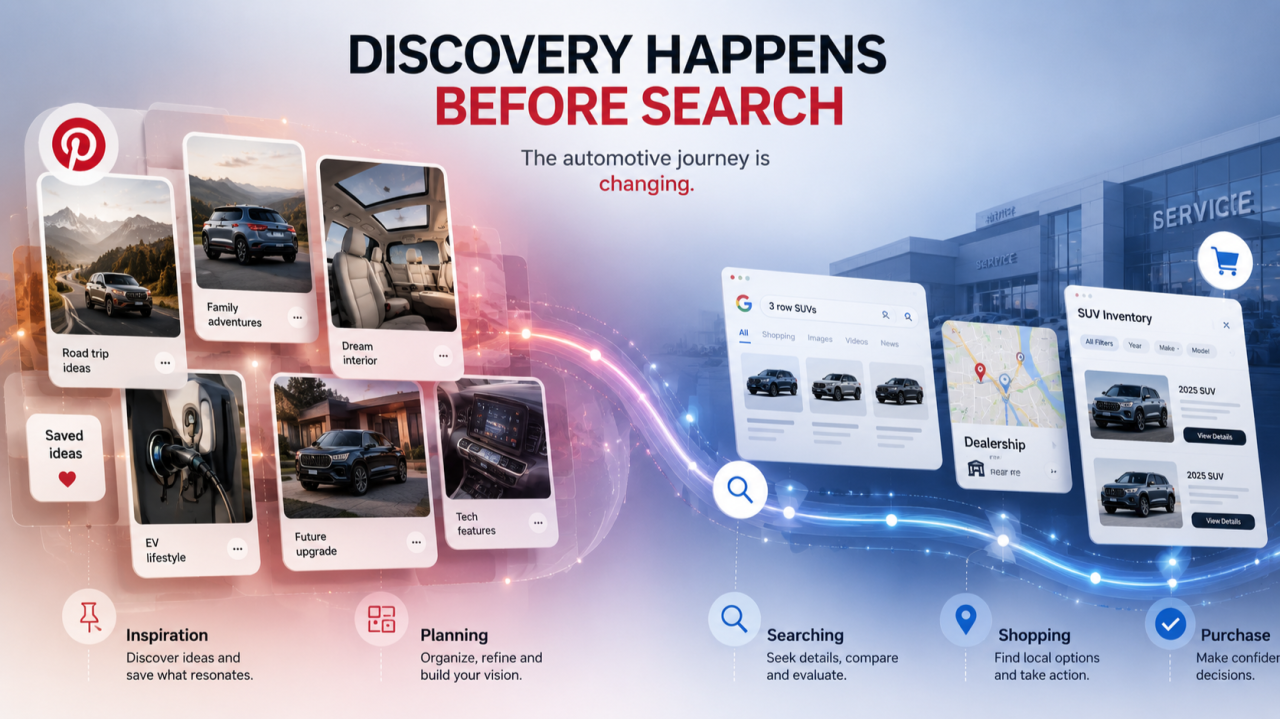
    Pinterest is increasingly becoming a visual discovery engine. And that matters because the way consumers search for products, brands, and ideas is changing quickly.

    For years, dealership advertising strategies have revolved around traditional search behavior: A shopper realizes they need a vehicle, goes to Google, searches inventory, and dealers compete aggressively at the bottom of the funnel.

    But consumer behavior is becoming far more visual and non-linear. People are discovering products before they intentionally search for them.

    And that shift has major implications for automotive marketing.

    Search Is Changing

    According to Pinterest’s 2026 “Reimagine Search” research, the platform now sees roughly 80 billion monthly searches with nearly 50% commercial intent.

    That is a massive behavioral shift hiding in plain sight.

    Pinterest users are not simply scrolling content. They are actively planning; purchases, lifestyle upgrades, family decisions, future goals, major life moments

    Pinterest sits in the space between inspiration and intent. And increasingly, that is where modern shopping behavior starts.

    Pinterest research also found that more than half of consumers have used Pinterest as a search engine, while two in three Gen Z shoppers prefer discovering products visually rather than through traditional text-based search.

    That should matter to every dealership thinking about the future of customer acquisition.

    Because younger consumers are not always beginning with keywords anymore. They are beginning with discovery.

    Discovery Happens Earlier Than Dealers Think

    The automotive industry still tends to define “intent” too narrowly.

    Most dealers focus heavily on the point where shoppers actively search inventory, compare payments, or submit leads. But influence starts much earlier than that.

    Someone researching a growing family may begin engaging with SUV content months before they search “best midsize SUV.”

    Someone planning a move may start exploring trucks long before they visit a dealership website.

    Someone researching EV ownership may begin consuming charging, lifestyle, and technology content before they ever compare models.

    Pinterest sits inside that planning phase of the journey.

    That matters because automotive purchase decisions are often heavily influenced long before someone enters a lower funnel campaign. Especially among female buyers, who influence the majority of vehicle purchasing decisions in the household.

    Pinterest Is Built for Visual Discovery

    This is also why Pinterest behaves differently than most traditional social platforms. It is not interruption-based. It is intent-based. Users actively save ideas, organize plans, refine preferences, and revisit content over time. That creates a very different relationship between the consumer and the advertising they see. And for automotive, this opens the door for more than just lower funnel messaging.

    Think about all these opportunities to use Pinterest to influence:

    • vehicle category consideration
    • lifestyle alignment
    • technology perception
    • design preference
    • EV education
    • family utility
    • luxury positioning

    Long before the shopper enters Google search or marketplace sites.

    Meanwhile, most dealerships still allocate the majority of spend toward the bottom of the funnel, competing for the same in-market shoppers after intent already exists.

    That creates a dangerous dynamic: Everyone is paying to capture demand someone else helped create.

    The Dealers Who Adapt Early Win

    Pinterest is no longer just an awareness platform.

    The platform supports:

    • shopping campaigns
    • inventory feeds
    • video
    • retargeting
    • conversion campaigns
    • offline attribution
    • AI-powered optimization

    In other words, it is a true full-funnel platform.

    The bigger takeaway is this: The future of automotive marketing clearly relies less on capturing searches and more on shaping discovery before the search ever happens.

    Because that is where consumer behavior is clearly moving.

    The dealerships that recognize that shift early will likely gain a significant advantage over the ones still treating every platform outside of Google and Meta as secondary.

    Search is changing.

    And dealerships may need to rethink where the buying journey actually begins.

  • Could Your Dealership Marketing Be Failing Without an Omnichannel Strategy?

    Could Your Dealership Marketing Be Failing Without an Omnichannel Strategy?

    Most dealership marketing doesn’t fail because of effort. It fails because of structure. There’s no shortage of spend, campaigns, or vendors. If anything, there’s more activity than ever.

    But activity isn’t the issue. Connection is.

    The Industry Built a Fragmented Model and Called It Strategy

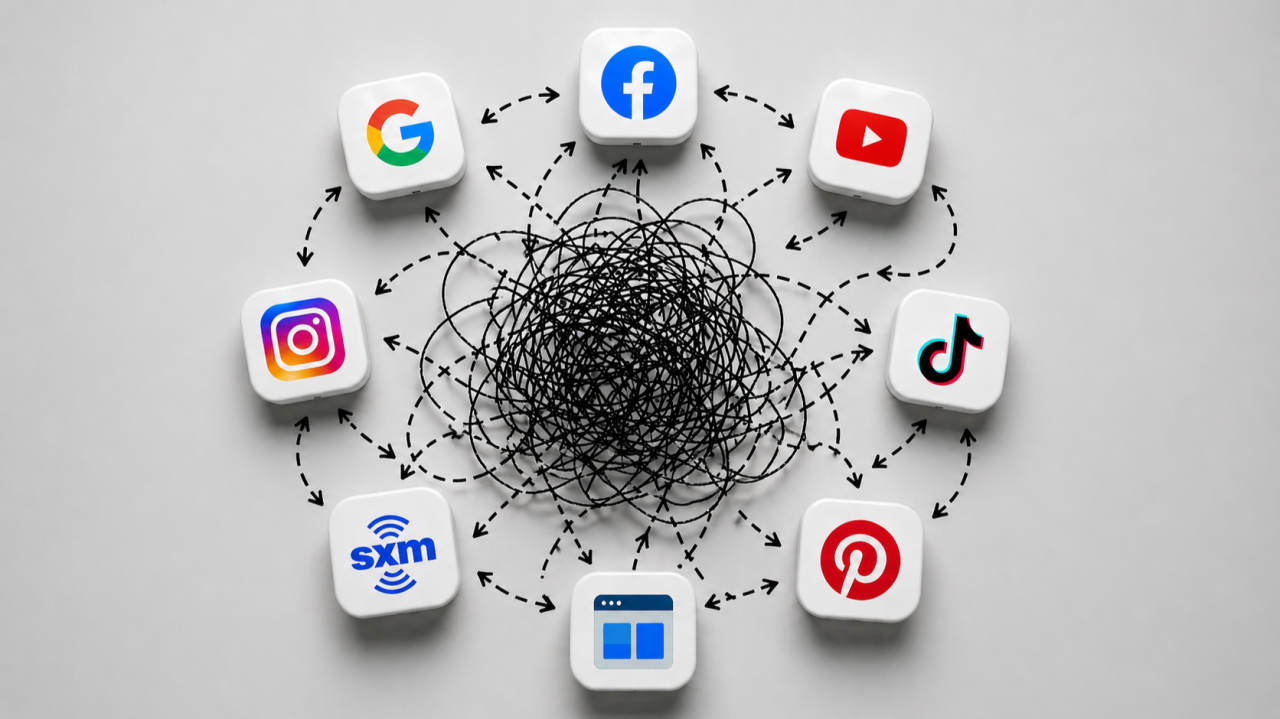
    Search is doing one thing. Social is doing another. Streaming, display, and email are all running in parallel.

    Different messages. Different timing. Different objectives. And somehow, we expect it to add up to growth.

    But it doesn’t. It creates noise.

    Because consumers don’t experience your marketing in channels. They experience it as a journey, where each moment builds on the last. When those moments don’t connect, the impact doesn’t build either.

    Fragmentation Doesn’t Just Limit Performance. It Caps It.

    Here’s the part most people miss.

    Fragmented marketing doesn’t just underperform. It has a ceiling.

    You can optimize each channel individually. Lower CPL. Improve CTR. Increase conversion rates. On paper, everything looks better.

    But if those channels aren’t working together, you’re just making disconnected pieces more efficient.

    You’re not increasing demand. You’re just competing harder for the same demand.

    The Buyer Journey Already Went Omnichannel. You Didn’t

    Today’s buyer doesn’t move in a straight line.

    They might see a video while scrolling, hear a brand while streaming audio, watch a longer-form spot on connected TV, then search when they’re ready.

    That sequence isn’t planned.

    But your marketing should be. Because when messaging connects across those moments, something changes. Recognition builds faster. Trust builds earlier. Decisions happen with less friction.

    Even the Platforms Are Telling You This

    This isn’t theory anymore. It’s how the largest media companies are thinking about growth.

    As our partners at SiriusXM Media put it:

    “Omnichannel execution amplifies your entire media mix: Extend your campaigns across streaming, podcasts, SiriusXM, video, and display to unlock incremental reach and frequency where it matters most.”

    That last part matters. Incremental reach and frequency.

    Not duplicated impressions. Not isolated clicks. Incremental impact.

    What Actually Changes With an Omnichannel Strategy

    When it’s done right, three things shift.

    1. Messaging becomes sequential, not repetitive. Each channel builds on the last instead of saying the same thing louder.
    2. Timing aligns with behavior. Awareness shows up early, consideration follows, and intent is captured when it’s real.
    3. Performance compounds. Channels stop competing with each other and start reinforcing each other.

    That’s where growth comes from.

    The Real Question

    If you turned off one of your major channels tomorrow, would anything actually change?

    If the answer is no, then your channels aren’t connected. They’re just coexisting.

    And that’s the difference between marketing that stays busy… and marketing that actually grows market share.

  • What Does the Modern Automotive Buying Journey Actually Look Like?

    What Does the Modern Automotive Buying Journey Actually Look Like?

    We’ve spent years trying to simplify the automotive buying journey into something clean.

    Awareness. Consideration. Intent. Urgency.

    It looks great on a slide. It tends to fall apart in the real world.

    The reality is the modern buyer doesn’t move in a straight line. They bounce. They pause. They disappear and come back. They consume content across multiple platforms before ever raising their hand. By the time a lead shows up or a search happens, most of the decision has already been shaped.

    A few months back I joined Jason Harris on the Modern Automotive Marketing podcast, and we spent a good amount of time unpacking this exact issue. The biggest takeaway is simple. The industry is still focused on the wrong part of the journey.

    The Journey Is Already in Motion Before You See It

    Think about how people actually shop today.

    A shopper might come across a video while scrolling at night. A few days later, they hear something during a podcast or streaming audio. At some point, they watch a review on YouTube. Maybe they click an ad, maybe they don’t. Eventually, they search a model or a dealership name and convert.

    That last step gets all the credit.

    But it didn’t do the heavy lifting.

    The decision was built slowly, across multiple moments and conversations that most dealerships never measure. Each touchpoint reduces uncertainty. Each interaction builds familiarity. By the time someone takes an action you can track, they are not starting the journey. They are finishing it.

    Where Most Strategies Break

    The issue is not effort. It’s focus.

    Most dealership strategies are still built around the bottom of the funnel. Paid search. Third-party leads. Retargeting. All designed to capture someone who is already in market.

    That creates a false sense of performance. Leads come in. Traffic looks stable. Everything feels like it is working.

    But nothing is actually growing.

    Because you are competing for the same pool of in-market shoppers as every other dealer in your market. You are not expanding demand. You are splitting it.

    The Part of the Journey That Actually Decides the Outcome

    The real leverage sits earlier than most teams are comfortable operating.

    Before someone searches. Before they submit a lead. Before they ever decide which two or three dealerships they are going to consider.

    This is where preference is formed.

    It’s where a shopper decides which brands feel relevant. Which dealerships feel trustworthy. Which model they feel an emotional connection to. Which options are even worth researching further. And it happens across channels that don’t show up cleanly in a CRM report.

    That doesn’t make it less important. It makes it more important.

    Because if you are not present in those moments, someone else is shaping the decision for you.

    Why Last-Click Thinking Keeps You Stuck

    Last-click attribution tells a very clean story. It shows you the final interaction and assigns it full value.

    The problem is that it confuses visibility with impact.

    Search looks like it drives everything because it is where people show up at the end. Lead providers look efficient because they package intent and hand it to you. Retargeting looks strong because it follows people who already showed interest.

    So budgets drift in that direction.

    Over time, more and more money goes toward capturing demand. Less and less goes toward creating it. Eventually, performance flattens. Not because the tactics stopped working, but because you are only fishing in the same pond.

    What Actually Moves Market Share

    The dealers that are gaining ground are not doing anything flashy. They are just playing a different game.

    They are showing up earlier. They are staying consistent across channels. They are using creative that matches where the shopper is in their journey, not just pushing offers at the end.

    More importantly, they are not relying on a single channel to do all the work.

    They understand that influence is cumulative. It builds over time. It requires presence in multiple places, not just dominance in one.

    That is what an integrated omnichannel strategy actually looks like in practice. Not more channels for the sake of it, but coordinated pressure across the journey.

    Again, a lot of what Jason and I talked about on Episode 1 of Modern Automotive Marketing.

    Final Thought

    The modern automotive buying journey is not broken. It’s just misunderstood.

    This is the question we kept coming back to on the podcast.

    If your bottom-of-funnel tactics disappeared tomorrow, what would happen to your demand?

    If the honest answer is that not much would change, then your marketing is not creating anything. It is just capturing what was already going to happen.

    And if that is the case, growth becomes very hard to build.

  • Are You Growing Market Share Or Fighting for It?

    Are You Growing Market Share Or Fighting for It?

    Most dealerships think digital marketing is about capturing demand.

    Someone searches. They click. They convert.

    That’s the playbook.

    And it works, to a point.

    But if that’s all you’re doing, you’re not growing market share. You’re competing for it.

    There’s a difference.

    Capturing Demand Is Not the Same as Creating It

    Capturing demand is reactive by nature. It shows up when a shopper is already in market, already researching, already narrowing their options. Search, retargeting, inventory-driven ads all sit here. They’re designed to intercept a decision that is already forming.

    That’s important. It should be part of every strategy.

    But it has a hard ceiling.

    There are only so many in-market shoppers at any given time. You’re not increasing that number. You’re just trying to win a larger share of it. And so is every other dealer in your market.

    That’s why performance starts to feel volatile. Costs creep up. Lead quality softens. Results flatten out.

    You’re fishing in the same pond. Just with more lines in the water.

    Creating demand changes the equation.

    It’s not about waiting for someone to raise their hand. It’s about influencing them before they ever get there. Before they search. Before they compare. Before they decide where they’re going to buy.

    That’s where market share actually shifts.

    The Ceiling Most Dealers Run Into

    If your strategy is built entirely around the bottom of the funnel, you will hit a wall. Period.

    It doesn’t matter how much you spend or how well your campaigns are optimized.

    At some point, you’ve exhausted the available demand.

    From there, the only way to grow is to pay more for worse outcomes or to squeeze incremental gains out of a shrinking pool of high-intent buyers. Neither is sustainable.

    This is where a lot of dealers get frustrated. The assumption is something is broken. In reality, the strategy just isn’t built to grow beyond a fixed opportunity.

    Market Share Is Won Earlier Than Most Think

    Here is the key: By the time a shopper searches, a meaningful portion of the decision has already been made.

    They’ve seen certain brands more often. They’ve started to recognize names. They’ve developed a level of comfort, even if they can’t explain why.

    That exposure doesn’t happen in search.

    It happens while they’re watching content, scrolling social, listening to audio, or streaming at night. Moments where they’re not actively shopping, but they’re forming preferences.

    If your dealership isn’t present in those moments, you’re not shaping demand. You’re stepping in at the end and hoping you can win it.

    Sometimes you will. Most of the time, you’re late.

    Upper Funnel Is Not a Branding Exercise

    This is where the conversation usually goes off track.

    Upper funnel gets labeled as awareness and written off as soft or hard to measure. So it gets deprioritized in favor of channels that show immediate conversion.

    But that thinking is exactly what caps growth.

    When it’s done right, you don’t just see more traffic. You see better traffic. Higher intent. Higher conversion rates. More stability in performance.

    You’re not just feeding the funnel. You’re widening it.

    The Real Question

    If your digital marketing disappeared tomorrow, would your market share change?

    If the answer is no, you’re not creating demand. You’re just capturing what was already there.

    And you don’t take market share by showing up at the end. You take it by shaping the decision before it starts.

  • Why Market Share Growth Matters

    Why Market Share Growth Matters

    As automotive retail leaders, we’ve traditionally measured success in units sold. Monthly reports, OEM targets, and incentive structures all reinforce one thing: sell more cars. But focusing solely on vehicle sales is an incomplete, and often misleading, view of performance.

    The more meaningful metric is market share.

    Market share reflects not just how many vehicles you sold, but how you performed relative to your competitors and the broader market. It answers a far more strategic question: Are we winning in our market?

    First, simply focusing on vehicle sales is not enough. In uncertain markets, like today’s environment shaped by affordability pressures and shifting consumer behavior, total industry sales can rise or fall independent of your dealership’s effectiveness.  A dealership can deliver higher sales and still lose ground competitively if the market grows faster than they do.

    Second, real opportunity lies in gaining share when the OEM or overall market is flat or declining. In periods where total sales soften, as we’ve recently seen, dealers who capture incremental share are effectively outperforming both their peers and the brand itself. These gains are often the result of disciplined execution: better inventory alignment, stronger digital presence, and superior customer experience.

    Third, long-term market dominance is far more valuable than short-term sales spikes. Research consistently shows that market share is one of the best indicators of competitive strength and future viability. Dealers with sustained share leadership benefit from greater brand visibility, stronger customer loyalty, and more predictable revenue streams. In contrast, chasing short-term volume often comes at the expense of margin, process discipline, and long-term positioning.

    Finally, market share growth compounds over time. Small, consistent gains build momentum – expanding your customer base, increasing service retention, and strengthening your reputation in the community. Brands with higher share tend to have more devoted and repeat customers, reinforcing a cycle of stability and growth. This compounding effect creates resilience, smoothing out the volatility that often defines automotive retail.

    The takeaway for today’s dealership leaders is clear: vehicle sales are a result; market share is a strategy.

    If we shift our focus from “How many did we sell?” to “How much of the market did we earn?”, we move from short-term thinking to long-term value creation.

    And in an industry as competitive, and cyclical as automotive, that shift makes all the difference.

  • Most Auto Dealerships Are Measuring Marketing Wrong

    Most Auto Dealerships Are Measuring Marketing Wrong

    The Problem with how Dealers are measuring marketing performance today.

    Most dealerships are still measuring marketing based on what’s easiest to track, not what actually drives growth.

    Number of leads. Cost per lead. Last-click attribution. Form fills.

    It looks clean. It gives you numbers to report. But it misses the point. These metrics tell you where a customer showed up, not what made them choose you.

    And if you are only measuring the last step, you are making decisions with incomplete information.

    So are you measuring what worked, or just what showed up last?

    Where Measuring CPL Breaks Down for Automotive sales.

    Last-click attribution has quietly reshaped how budgets get allocated.

    It rewards the channel that captures demand, not the ones that create it. So spend keeps consolidating into search and retargeting, while upper and mid-funnel efforts get reduced or eliminated.

    At first, performance looks efficient. You are capturing existing demand at a lower cost. But over time, that demand pool shrinks. Traffic plateaus. Lead flow becomes inconsistent. You end up competing harder for the same in-market buyers.

    Cost Per Lead creates a similar illusion.

    You can drive it down by opening up targeting or pushing more aggressive lead tactics. The number improves, but lead quality drops. Sales teams feel it immediately through lower close rates and weaker gross.

    Nothing is actually improving. It is just being measured differently.

    What Actually Matters for Dealerships in 2026

    The shift is not about adding complexity. It is about looking at performance the way buyers actually behave.

    1. First, focus on trend over snapshots. Marketing is momentum. Weekly traffic patterns, new users, and engagement tell you whether demand is building or fading. If those signals are moving in the right direction, future conversions follow. If they are flat, you are not creating enough new demand.
    2. Second, think in terms of the full funnel. Buyers do not go from click to conversion in one step. They move through awareness, consideration, intent, and urgency. Different channels influence different stages. When those channels are working together, performance stabilizes. When they are not, you see volatility and over-reliance on a few tactics.
    3. Third, shift from cost per lead to cost per buyer. Leads are easy to generate. Buyers are not. When you measure against actual sales outcomes, it forces alignment between marketing and real business performance. It also makes it easier to diagnose problems. Poor audience quality, weak mid-funnel engagement, or breakdowns in the store all become more visible.
    4. And finally, performance has to be viewed in context. Market conditions, incentives, inventory levels, and competitive pressure all influence results. Static reporting misses that. The best operators adjust based on what is happening now, not what worked last month.

    The Bottom Line for your Auto Dealership.

    This is not about abandoning metrics. It is about upgrading them to match how marketing actually works.

    From CPL to cost per buyer. From last-click to full-funnel impact. From isolated results to directional trends.

    Because the goal is not to generate more activity. It is to create demand, capture it, and convert it profitably.

    And if you are not measuring that, you are guessing.

  • If You’re Guessing Your Ad Budget, You’re Already Losing

    If You’re Guessing Your Ad Budget, You’re Already Losing

    Let’s have a little fun with this.

    It’s April Fools’ Day, which feels like the perfect time to ask a serious question:

    Where should dealers actually be spending their advertising budget right now?

    If your answer is some version of “what worked last month” or “I have no clue,” you’re not alone.

    You’re also not operating a strategy. You’re operating a habit.

    And without real guidance or data, as David Raminick often suggests,

    “you might as well light your money on fire.”

    The Market Isn’t Static. Your Budget Still Is.

    Most dealers don’t realize how much the ground is shifting under them.

    Demand doesn’t move in straight lines anymore. It comes in waves. It reacts to incentives, inventory, interest rates, competitor pressure, even weather patterns. And it moves faster than most teams can keep up with.

    But budgets? Budgets are still set like it’s 2018. Locked into the same channel mix. The same allocations. The same expectations.

    Search gets its share. Meta gets its share. Maybe a little gets tested elsewhere. Then everyone sits back and hopes performance holds.

    Sometimes it does. A lot of times it doesn’t.

    But guess what??? Hope isn’t a strategy.

    The Real Question Isn’t Just Where. It’s Also When.

    “Where should we spend?” is the wrong question.

    The better question is:

    Where should we be spending right now, based on how the market is behaving today?

    Because the right mix in week one of the month might be completely wrong by week three.

    If your strategy doesn’t account for that, you’re always reacting late.

    Proficy Digital Media Mix Modeling

    What Media Mix Modeling Actually Changes

    This is where Media Mix Modeling stops being a concept and starts becoming a competitive advantage.

    At Proficy Digital Inc., we don’t treat it as reporting. We use it as a decision engine that actively guides where budget should move next.

    At its core, it answers a simple but critical question: If I move a dollar, what actually happens next?

    Not just within a single channel, but across the media mix.

    It shows you exactly where your budget should be for each channel and what adjustments, if any, should be made. It takes the guess work out of budget adjustments and removes risk from your advertising strategy.

    Most importantly, it gives you direction in real time.

    So instead of setting a plan and hoping it holds, you are adjusting spend based on how the market is actually behaving as it unfolds. Because without that level of guidance, every budget decision is just an opinion dressed up as a strategy.

    What the Best Dealers Are Doing Differently

    The dealers gaining ground right now aren’t guessing.

    They’re adjusting in real time. When demand softens, they build it. When intent spikes, they capture it. When something works, they scale it immediately.

    No rigid allocation. Just alignment with the market.

    At Proficy Digital, this is how we operate. Media Mix Modeling guides where budget moves next, not where it went last. Because the goal isn’t to be right once a month. It’s to stay right as the market changes.

    One Final Thought

    April Fools’ Day is meant for harmless jokes, but your advertising budget shouldn’t be one of them.

    If your budget doesn’t evolve with the market, it’s not strategy.

    It’s a guess. And in this environment, that gets expensive fast.

  • Why Lead Generation Is Limiting Your Growth

    Why Lead Generation Is Limiting Your Growth

    Lead generation didn’t stop working. It just stopped working the way most dealerships think it does.

    And in a lot of cases, it has quietly become the ceiling on growth.

    For years, automotive marketing has been built around one question: how many leads did we get? That question has shaped strategy, budgets, and how success is measured.

    It feels logical.

    More leads should mean more sales.

    But that’s where things start to break.

    The Industry Optimized for Volume

    When your dealership marketing strategy is built around lead volume, everything shifts in the wrong direction.

    Platforms are pushed to find the cheapest conversions, not the best buyers. Campaigns lean into short-term capture instead of long-term influence. Sales teams spend more time sorting than selling.

    So ask yourself:

    Are we generating more leads, or just more noise?

    Because those are not the same.

    • Cost per lead goes down
    • Close rates follow
    • Effort increases across the board

    It shows up as progress in reporting.

    But its probably friction everywhere else.

    Your Best Buyers Aren’t Leads

    The lead model assumes interested buyers will raise their hand.

    That assumption is outdated.

    Today’s highest-value buyers:

    • Research across multiple platforms
    • Watch and compare before ever clicking
    • Narrow decisions before engaging
    • Often never submit a single lead form

    So the real question is:

    How many of your best buyers never became a lead?

    If your automotive marketing strategy only measures form fills, clicks and calls, you are missing the most valuable part of your market.

    Are You Optimizing for the Wrong Outcome?

    Platforms do exactly what you tell them to do.

    If you optimize for leads, they will find people who submit forms. Not people who buy.

    That creates a gap between activity and growth.

    • Lead volume looks healthy
    • Conversion efficiency declines
    • True performance becomes harder to scale

    So it’s worth asking:

    Are your campaigns finding buyers, or just people willing to click?

    Growth Comes From Influence

    Dealership growth doesn’t come from capturing demand alone. It comes from influencing it.

    The dealerships pulling ahead are not waiting for shoppers to convert. They are showing up earlier, staying present longer, and shaping decisions before intent is obvious. This is key!

    That’s full-funnel marketing.

    Not more activity. Better timing and better positioning.

    Because if you only show up at the moment of conversion, you’re already late.

    The Shift

    The goal is not more leads.

    It’s better buyers.

    That requires a different approach:

    • Prioritize audience quality over volume
    • Invest beyond the bottom funnel
    • Use creative that builds intent, not just captures it
    • Measure what actually drives revenue

    A better question to ask:

    How do we influence more high-quality buyers before they ever raise their hand?

    The Bottom Line

    Lead generation isn’t broken.

    But if it’s your primary strategy, your growth is capped.

    Because you’re only competing for the buyers who have already decided to shop.

    And ignoring everyone else.

  • AI Is Everywhere in Automotive Marketing. How Much of It Is Noise?

    AI Is Everywhere in Automotive Marketing. How Much of It Is Noise?

    A quick Google search for “automotive AI” yields hundreds of results.

    • Chatbots.
    • Lead response tools.
    • Service scheduling assistants.
    • Conversational sales agents.

    Most of the AI currently being marketed to dealerships falls into one of two categories:

    Conversational AI or agentic AI.

    These tools are designed to interact with customers. They answer questions, schedule appointments, respond to leads, and help sales teams manage communication more efficiently.

    There is real value in that. Responding faster to leads improves conversion. Better customer interaction improves experience. But I would argue that is just one piece of the puzzle.

    Because while the industry is focused on AI answering questions from shoppers, very little attention has been paid to something far more impactful:

    Using AI to decide how advertising dollars should move.

    Another, Possibly Bigger Opportunity for AI

    While conversational and agentic AI focus on customer interaction, a much larger opportunity exists on the decision-making side of marketing.

    Every dealership today is generating an enormous amount of data across its advertising ecosystem:

    • Search behavior
    • Inventory shifts
    • Audience engagement
    • Creative performance
    • Geographic demand patterns
    • Historical sales cycles

    Taken together, these signals represent millions of potential data points that influence advertising performance. Yet most advertising decisions are still made using a handful of reports and human interpretation. Most often, budget shifts happen monthly. Campaign changes happen periodically. Optimization happens after performance is already visible.

    In a market that moves as quickly as automotive retail, that approach creates lag.

    What if Advertising Worked More Like Day Trading?

    A better way to think about modern advertising could be through the lens of financial markets. Day traders evaluate enormous volumes of signals continuously; Price movement, Market momentum, Volume changes , External news, Historical patterns.

    Capital moves dynamically based on probability.

    Modern advertising should work the same way.

    AI systems can evaluate signals such as; Search demand trends, Inventory availability, Audience behavior patterns, Creative engagement signals, Geographic performance shifts

    Investment can then move dynamically toward the highest probability of creating incremental shoppers or generating sales or service demand.

    Humans Still Set the Strategy

    None of this removes the importance of human strategy.

    AI can analyze signals and execute decisions quickly, but it still requires clear direction.

    Humans define the business priorities:

    • Should the focus be market share growth or used vehicle velocity?
    • Should the strategy prioritize conquesting competitors or defending the core market
    • Should fixed ops retention become a primary growth driver?

    Those decisions require both experience and an understanding of dealership operations.

    Once the strategy is defined, AI becomes the execution engine.

    The Future of the Automotive Digital Agency

    This shift will change the role of the automotive digital agency.

    Agencies will no longer be defined simply by their ability to manage campaigns or produce creative.

    The real value will come from building systems that can:

    • Process massive volumes of data
    • Identify patterns humans cannot see
    • Allocate budget dynamically
    • Continuously improve performance

    In other words, the future agency will operate more like a decision engine than a campaign manager.

    The Real Question, IMO…

    The real question is not whether AI belongs in automotive marketing.

    That answer is already clear.

    The real question is where it could be applied.

    Conversational and agentic AI can improve speed, responsiveness, and customer experience. That matters. Faster responses to shoppers can absolutely improve conversion. But there may be an equally important opportunity emerging elsewhere.

    Should AI focus only on answering questions from shoppers?

    Or should it also help decide something far more consequential:

    Where millions of advertising dollars should move next?

    Because if AI can both improve customer conversations and guide smarter marketing investment, the impact on dealership performance could be far greater than either one alone. And that may be where the next real evolution of automotive AI begins.