Category: Articles

  • Why Human Review Still Matters in an AI World

    Why Human Review Still Matters in an AI World

    I’m sure there are hundreds of articles out there making some version of the same argument: AI is powerful, but we still need humans.

    I don’t disagree. I just don’t think that’s the interesting part anymore.

    AI is getting very good at doing work that, not long ago, required a person. It can analyze thousands of signals, identify patterns, create content, recommend where to move money and, increasingly, take action without waiting for someone to tell it what to do. The question isn’t whether we should keep a human somewhere in that process. It’s where human judgment actually makes the outcome better.

    Because simply keeping a person involved doesn’t guarantee that it will.

    The real value comes from having someone who understands the business well enough to recognize when a perfectly reasonable AI recommendation is wrong for the situation in front of them.

    That’s an important distinction, particularly in automotive, where AI adoption is moving much faster than most people probably realize.

    Adoption Is the Easy Part

    According to Cox Automotive’s 2026 AI in Auto Retail Tracker;

    82% of dealers are already using AI in some capacity. But adoption and impact aren’t necessarily moving at the same pace. While 69% of dealers expected AI to drive sales and revenue growth, only 22% of AI users reported seeing that growth so far. Accuracy and errors are also among dealers’ biggest concerns. (Cox Automotive)

    Simply having access to AI isn’t much of a competitive advantage anymore. How well an organization feeds it, evaluates it and applies what it produces is becoming much more important.

    Think about that in the context of advertising.

    An AI system could look across a dealership’s inventory, market demand, competitive activity and advertising performance and recognize that a particular model is sitting at 70 days’ supply. Search demand is increasing, competitors are gaining share and an OEM incentive has just made the offer more compelling. Based on those signals, the system recommends shifting more media toward that model.

    That’s exactly the kind of work we should want AI doing. A person shouldn’t have to spend hours digging through reports to find something a machine can identify in seconds.

    But maybe several of those vehicles are already spoken for. Maybe the dealer is intentionally protecting gross. Maybe another shipment arrives next week. Or maybe the store has already hit its OEM objective and the priority for the final few days of the month is somewhere else.

    The AI’s analysis may be completely logical based on the information available to it. It just might not be the right business decision.

    Over time, more of that context will become data too. In my opinion, it should. But even as AI gets a more complete view of the business, someone still needs to understand what the dealership is trying to accomplish and whether the action being recommended actually moves it in that direction.

    When a Good Answer Becomes the Wrong Decision

    Research outside automotive shows just how important that distinction can be.

    Researchers from Harvard Business School, Wharton, MIT and Boston Consulting Group studied 758 BCG consultants performing realistic knowledge-work assignments. When the assignments fell within AI’s capabilities, consultants using GPT-4 completed 12.2% more tasks, worked 25.1% faster and produced significantly higher-quality work.

    Then researchers gave them a task intentionally designed to sit outside AI’s capabilities. Consultants using AI were 19 percentage points less likely to produce the correct answer than those working without it. The researchers described this uneven boundary between what AI does extremely well and what it does poorly as the “jagged technological frontier.” (Harvard Business School)

    What makes that finding so interesting isn’t that AI sometimes gets things wrong. Everyone already knows that. It’s that capable people can perform worse when they trust AI in the wrong situation.

    And simply putting a human in the loop doesn’t automatically fix it. If a system makes a recommendation and a person simply clicks approve because the output looks reasonable, we haven’t added much intelligence to the process. We’ve added another step.

    The answer isn’t simply human-in-the-loop. It’s expert-in-the-loop.

    AI Still Has to Learn the Business

    Across automotive, the conversation is already moving beyond whether AI belongs in the dealership. The more important question is where it should operate autonomously and where experience, context and judgment still change the outcome.

    Advertising is a good example.

    AI can monitor thousands of signals continuously, identify changes in demand, analyze inventory and competitive activity, forecast outcomes and find opportunities faster than any person realistically could. That’s exactly what we should want it doing.

    The same is true for creative. AI can produce and adapt image, video and audio at a scale that would have been nearly impossible just a few years ago. Offers can change quickly. Messaging can become more localized. Creative can respond to inventory, demand and where a customer is in their buying journey.

    But more creative isn’t automatically better creative, just as more data doesn’t automatically lead to better decisions.

    Someone still has to understand the market, the dealership and the objective well enough to know whether the message makes sense. Is it accurate? Is it relevant to what the dealership actually needs to accomplish? Does it reflect the brand? And, sometimes most importantly, is it actually good?

    That’s where the combination becomes powerful. AI creates the scale and speed. Human judgment makes it relevant.

    Human Review Has to Evolve With AI

    That doesn’t mean slowing AI down. If a system identifies an opportunity, analyzes the data, creates the assets and recommends an action, only to wait three days for five people to approve every step, we’ve missed a large part of the benefit.

    As the technology improves, the relationship should evolve. Today, an expert may review a recommendation before the system acts. Tomorrow, the system may operate within established guardrails and only surface the exceptions that require attention. The human role moves away from manually touching every decision and toward setting strategy, adding context and making sure the system is solving for the right business outcome.

    AI gives us the ability to apply intelligence at a scale and speed we’ve never had before. But scale also means a bad assumption can travel faster, a poor decision can be repeated thousands of times and an answer that looks right can be acted on before anyone asks whether it makes sense.

    The companies that get the most from AI won’t be the ones that automate everything simply because they can. They also won’t be the ones that insist a person touch every decision. They’ll be the ones that figure out what machines should do, what people should do and where expert judgment creates the most value.

    Because the real opportunity isn’t replacing human judgment with artificial intelligence.

    It’s using artificial intelligence to put better human judgment to work at a scale that was never possible before.
  • Can Omnichannel Marketing Work Without Automation?

    Can Omnichannel Marketing Work Without Automation?

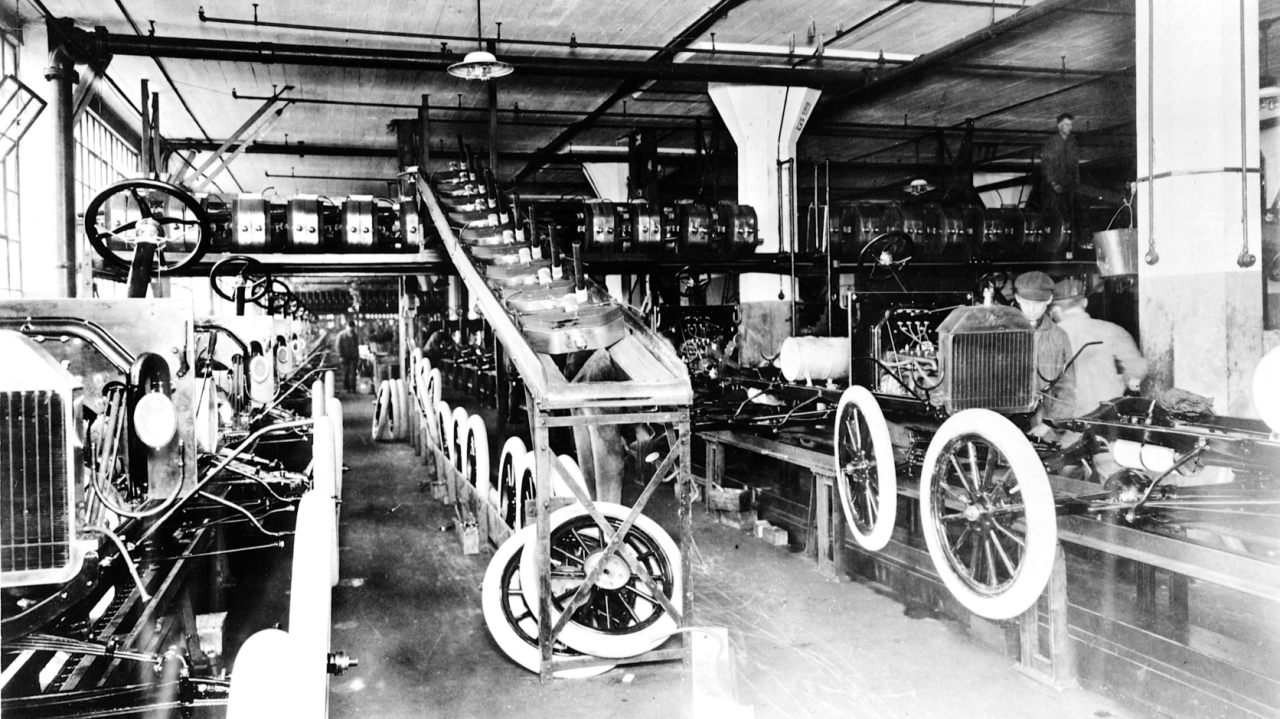
    In 1913, Ford’s moving assembly line changed what was possible in automobile production.

    The breakthrough was not simply speed. Ford created a coordinated system in which every person, tool, and process worked together toward the same outcome.

    Modern omnichannel marketing faces a similar execution challenge.

    When new incentives arrive, the clock starts. Search copy needs to change. Graphics and videos need to be created. Campaigns, landing pages, and inventory feeds need to be updated.

    If it takes days or weeks for an offer to reach every channel, the dealership does not have an omnichannel strategy.

    It has a collection of channels waiting on a production process.

    As we explored in our previous article, omnichannel marketing is not simply being present on multiple platforms. It is aligning data, media, creative, and the dealership website around one connected customer journey.

    Automation is what makes that possible at scale.

    Why Omnichannel Breaks Down

    According to Salesforce, marketers use an average of 10 customer engagement channels. High-performing marketers personalize experiences across an average of six. Yet only 31% are fully satisfied with their ability to unify data. (Salesforce)

    On paper, that sounds like a technology problem. Inside a dealership’s marketing operation, it quickly becomes a timing problem.

    Every new incentive, price change, inventory priority, or service offer can trigger dozens of updates. Each platform has its own dimensions, formats, targeting rules, landing pages, and approval processes.

    When every update depends on a separate manual handoff, campaigns become fragmented. One channel promotes the current incentive while another is still running last month’s message. Traffic reaches a page that does not match the ad that generated the click.

    The dealership may be advertising everywhere, but the consumer is not experiencing one connected strategy.

    A message that reaches every channel two weeks late is not omnichannel. It is coordinated irrelevance.

    What Automation Actually Changes

    Automation turns an omnichannel plan into something that can actually be executed.

    One approved offer can be adapted into channel-specific creative. Inventory changes can flow into dynamic campaigns. Video, graphics, copy, and audio can be created for different audiences and stages of the buying journey without starting over every time something changes.

    That does not mean running the same advertisement everywhere.

    A 15-second video has a different job than a paid search ad. Streaming audio should not sound like someone reading a Meta post. A shopper seeing the dealership for the first time should not receive the same message as someone actively comparing a specific vehicle.

    The strategy remains connected, but the execution fits the channel and the consumer’s stage in the journey.

    Automation removes the production bottlenecks that force dealerships to choose between speed and relevance. It also gives people more time to focus on the decisions that should not be automated: which vehicles need support, where the dealership can gain share, what message will move the market, and where the next dollar should be invested.

    Automation is not the strategy. It keeps the strategy from getting buried under manual work.

    Why Speed Matters

    Automotive advertising operates on a compressed clock.

    New incentives, aged inventory, model priorities, sales objectives, and competitive pressures can change every month. Creative needs to be developed and deployed while those opportunities still have enough time to influence the outcome.

    Speed matters after launch too. Nielsen found that only 32% of marketers measure media spending holistically across digital and traditional channels. (Nielsen)

    That makes it difficult to see how channels are working together or where budget should move next.

    A connected system can identify where demand is being created, where intent is being captured, and which business priorities need more support. Automation turns those insights into action while there is still time for the changes to matter.

    Ford’s assembly line did not succeed because it added more workers or more stations. It succeeded because it connected the entire production process.

    The same principle applies here.

    The modern dealership does not need more places to advertise. It needs a system capable of making those places work together.

  • Why Marketing Teams Need AI Assistants, Not AI Replacements

    Why Marketing Teams Need AI Assistants, Not AI Replacements

    The conversation about AI in marketing has become unnecessarily binary. Either AI will revolutionize marketing or it will replace marketers. I believe both views miss the bigger opportunity.

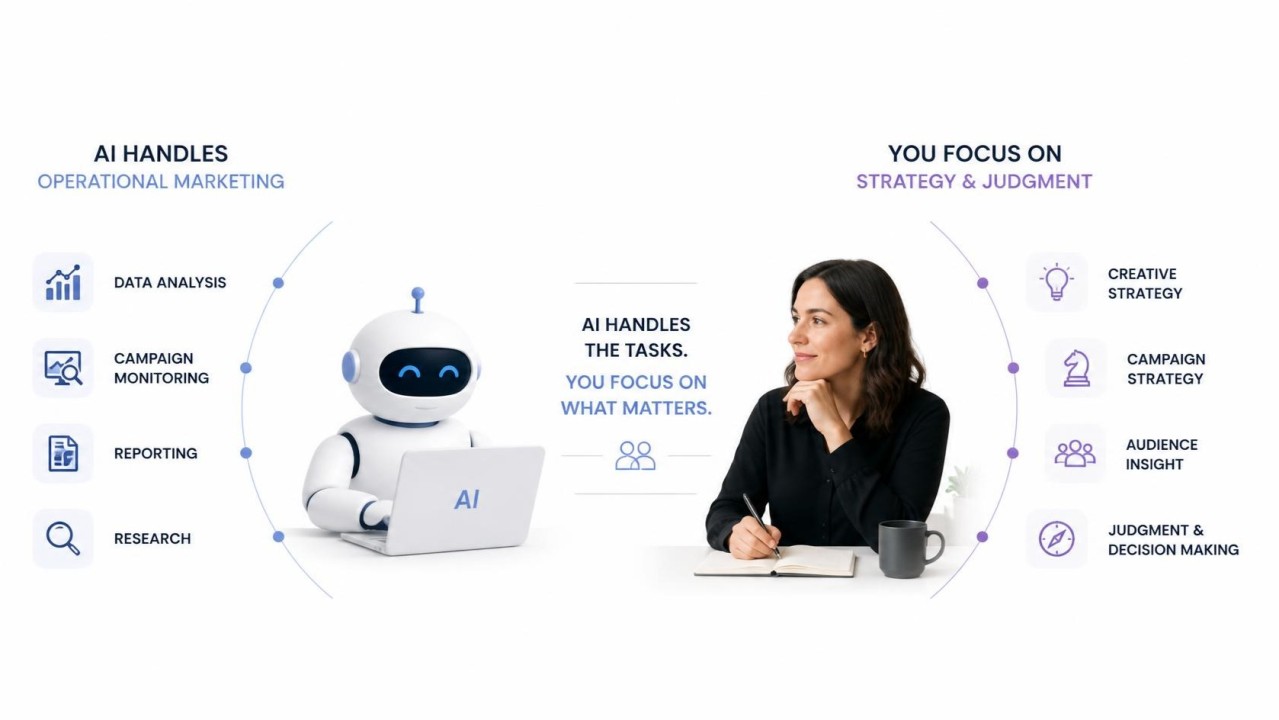
    The real opportunity is to give every marketer an AI assistant that removes the operational burden surrounding the work, allowing people to spend more time on the work that actually requires judgment, creativity, strategy, and business understanding.

    That distinction matters.

    AI can change that equation.

    The Productivity Opportunity Is Already Here

    AI adoption is no longer theoretical. McKinsey’s 2025 global research found that 71% of organizations regularly use generative AI in at least one business function, with marketing and sales among the functions with the highest adoption rates.

    Marketing-specific research points to an even clearer reason for adoption. The 2025 State of Marketing AI report, based on nearly 1,900 marketers and business leaders, found that 82% of marketers identified reducing time spent on repetitive, data-driven tasks as their primary desired outcome from AI. Sixty percent of respondents said their marketing teams were already either piloting or scaling AI.

    That tells us something important: marketers aren’t primarily asking AI to replace themselves. They’re asking it to give them back time.

    AI Should Remove Work, Not Remove Judgment

    Consider what happens when an AI assistant handles the operational layer of a marketing workflow.

    It can monitor campaign performance, summarize anomalies, organize audience data, draft creative variations, identify inventory changes, prepare reporting, research competitors, build initial media recommendations, and surface opportunities that would otherwise require hours of manual analysis.

    The marketer remains responsible for deciding what matters, why it matters, and what the business should do about it.

    That is the distinction between automation and augmentation.

    McKinsey estimates that agentic AI could eventually power roughly 60% of tasks across the marketing process, including content generation, audience testing, media planning, and campaign execution. Its research also estimates that agentic systems could accelerate campaign creation and execution by 10 to 15 times.
    Those numbers don’t suggest that marketing departments need 60% fewer people.

    They suggest that marketers could potentially accomplish dramatically more with the same people.

    The Biggest Risk Is Using AI Too Narrowly

    The first generation of marketing AI has largely been used as a collection of productivity tools: write this email, summarize this report, create five headlines, generate an image.

    The greater opportunity comes when AI becomes embedded into the workflow itself.

    Imagine an AI assistant that knows the dealership’s inventory, historical performance, market conditions, customer segments, media strategy, brand standards, and current promotions. Instead of asking it to write an ad, the marketing team could ask:

    Where are we seeing an emerging opportunity, and what should we do about it?

    The assistant could identify a demand shift, determine which audiences are affected, recommend where budget should move, develop appropriate creative variations, and prepare the campaign for human approval.

    The marketer becomes the strategist and decision-maker rather than the person assembling the pieces.

    Human Creativity Becomes More Valuable, Not Less

    The more AI handles repetitive execution, the more valuable human creativity and judgment become.

    AI can produce 100 versions of an advertisement. It cannot independently determine which strategic idea will change how consumers perceive a dealership or brand.

    It can generate a recommendation. An experienced executive needs to determine whether the recommendation aligns with the company’s objectives, economics, brand, and risk tolerance.

    This is why the strongest organizations are moving toward human-AI teams, not human-versus-AI teams. McKinsey’s latest research describes the future of work as a partnership between people and intelligent agents, with humans increasingly focused on judgment, relationships, creativity, and higher-value decisions.

    LinkedIn and Ipsos found a similar pattern in their 2025 research: marketers who embed AI into strategy, rather than limiting it to execution, reported 13% higher revenue growth and 13% greater cost savings than their peers.

    The Competitive Advantage Is What Marketers Do With the Time

    The objective should be to eliminate the work that prevents marketers from doing their best work.

    If AI can turn a four-hour reporting exercise into a 10-minute review, the win isn’t the three hours and 50 minutes saved. The win is what the marketer does with those hours: better planning, sharper creative, deeper customer understanding, faster decisions, and more time focused on growth.

    That’s the real AI opportunity.

    AI shouldn’t replace the marketer. It should make the marketer more capable.

    The organizations that understand that distinction will not simply use AI to reduce costs. They’ll use it to increase the speed, intelligence, and strategic capacity of their marketing teams.

    And that is a much bigger competitive advantage.

  • If Your Data Can’t Change the Month, What’s It For?

    If Your Data Can’t Change the Month, What’s It For?

    Today is the last day of the month.

    Across the industry, dealership leaders are reviewing sales, gross, inventory, advertising performance and everything else that contributed to the final result. Reports are being assembled. Dashboards are being opened. Vendors are preparing to try explain what worked.

    But the most valuable question may not be what happened this month.

    It may be what could have been different if the dealership had seen the right information sooner.

    Could more budget have moved toward a model gaining momentum? Could spend have been reduced on inventory that was already moving? Could a market showing stronger demand have received additional support? Could the creative or offer have changed before performance began to decline?

    Those are not reporting questions. They are decision-making questions.

    And answering them requires more than simply having more data.

    Having Data Isn’t the Same as Having Clarity

    Most dealerships have access to more information than ever before. Inventory systems, CRM platforms, website analytics, advertising platforms, market data and DMS records all produce a constant stream of numbers.

    Yet access has not necessarily created clarity.

    According to the Cox Automotive 2024 Power of Data Study, 83% of dealerships have access to insights through a dashboard or reporting tool, but fewer than one-third are satisfied with the insights they receive from vendors.

    The same study found that 54% of dealers have experienced conflicting data across multiple sources. Seventy percent said delays in receiving real-time customer, lead and vehicle data make their insights less useful. Only 26% said they were confident in third-party insights.

    The problem is not a lack of data. It is that too much of the data arrives late, conflicts with another source or cannot be connected to an actual business outcome.

    A dealership can have several dashboards open and still lack a reliable view of what is happening.

    More Data Can Create More Confusion

    Imagine trying to decide where the dealership should spend its next advertising dollar.

    One platform shows strong traffic. Another reports efficient conversions. The CRM credits leads to a particular source. Inventory data shows what needs support. Sales data shows what is actually moving. Market data reveals where demand is changing.

    Each may be accurate. But if those signals are not connected, the dealership is left trying to determine which one should drive the decision.

    A channel may look successful because it generated clicks or leads while doing little to influence sales. Another may look less efficient while reaching shoppers earlier in the journey or supporting a greater market opportunity.

    More disconnected data does not solve that problem. It scales it.

    More data tells a dealership more things. Good data tells it what to do next.

    What Normalized Data Actually Means

    Data normalization sounds technical, but the idea is simple: make sure all of the dealership’s data is speaking the same language.

    Inventory, advertising, website activity and sales results need to connect. That gives the dealership a clearer picture of where to spend, what to promote and what is actually influencing sales.

    Good data should be accurate, current and connected to what the dealership is trying to accomplish.

    That does not mean every sale can be tied neatly back to a single ad. Hate to tell you but automotive shopping just does not work that way.

    An Autotrader analysis using Clarivoy data examined 875,000 vehicle sales and found that only 8% were traceable in the CRM. The average buyer encountered 62 touchpoints during the shopping journey, while the average dealership tracked only two.

    If advertising is evaluated only through CRM leads or the final recorded source, most of the customer journey is missing.

    Connected data provides a better view of what is actually working, so marketing decisions can be made around business results rather than individual platform metrics.

    As Chase Abbott of Cox Automotive put it:

    “Data is worth doing right. With high quality, accurate, and secure data delivered in real time, dealers can unlock powerful insights.”

    Reporting Explains the Month. Good Data Helps Change It.

    Traditional reporting looks backward. It tells you which campaigns delivered impressions, which channels drove traffic and which sources generated leads.

    Useful information. But if it only explains what already happened, it cannot change the result.

    Good data should help a dealership make decisions while there is still time to affect the month.

    Where should the next advertising dollar go? Which models need more support? Where is demand building? Which markets represent real opportunity? Which channels are actually influencing sales, not simply claiming the last conversion?

    Those are the questions that matter.

    When inventory, advertising, website activity and sales data are connected, marketing becomes more responsive. Budget can move toward opportunity. Spend can come out of areas that no longer need it. Creative can change with inventory, offers and demand. Channels can be evaluated by the role they play in producing the business result.

    The goal is not to explain the month better. It is to make better decisions before the month is over.

    Reporting explains the month. Good data helps you change it.

    The Goal Is Better Decisions

    The objective is not to build a larger dashboard or add another report to the month-end meeting.

    It is to make the next decision with more confidence.

    As this month closes, every dealership will have numbers to review. The real test is whether those numbers arrived early enough, connected clearly enough and led to action.

    If the first reliable view of performance appears after the month is over, the opportunity to change the result is already in the rearview mirror. The best data does not just tell you how the month ended.

    It helps you change how it ends.

  • Why Speed to Market Is the New Competitive Advantage

    Why Speed to Market Is the New Competitive Advantage

    An OEM announces its new incentives on the 2nd of the month.

    There is a compelling lease offer on a high-volume model. Maybe there is bonus cash on another vehicle the dealer has plenty of sitting on the ground. At that moment, every dealer has access to essentially the same opportunity. The difference is how quickly they can act on it.

    For many dealerships, that’s where the clock starts ticking. New creative needs to be built, offers need to be incorporated across different formats and campaigns need to be updated across channels. What sounds like a relatively simple change can turn into days of production and deployment.

    By the time the new advertising is actually running, it is the 14th.

    Nearly half the month is gone.

    That process has been accepted as normal in automotive advertising for a long time. It shouldn’t be anymore.

    Speed to market is becoming a competitive advantage.

    The Cost of Being Late

    Most dealerships operate in highly competitive markets, selling the same vehicles, promoting the same OEM incentives and competing for the same consumers. The advantage isn’t always having something your competitors don’t. Sometimes it’s simply getting there first.

    Every day a new incentive isn’t in market is a missed opportunity. And this isn’t just about updating a paid search ad. Consumers move across search, social, streaming video, Connected TV, audio and other digital channels. If an offer matters, it should be reflected across that experience.

    That’s where traditional production slows things down. A still image is one thing. Building video, audio and channel-specific creative takes longer. By the time everything is produced and deployed, a meaningful portion of the offer window may already be gone.

    The campaign may eventually be right.

    It was just late.

    From Production Cycle to Same-Day Opportunity

    This is where automation, data and AI can fundamentally change the process.

    OEM incentives can be ingested as they become available. Dealer-specific offers can be incorporated alongside them. Inventory data can identify which models are actually in stock and worth supporting.

    From there, automated creative production can turn those inputs into the formats required across channels, including still images, video and audio.

    What used to be a production cycle can become a deployment cycle.

    The target should increasingly be same-day speed to market.

    That doesn’t mean removing people from the process or blindly publishing every offer that appears in a data feed. Dealers still need control over their strategy, messaging and what they choose to promote.

    It means eliminating the unnecessary time between deciding an offer matters and actually putting it in front of consumers.

    Automation isn’t valuable because it eliminates work. It’s valuable because it eliminates delay.

    Speed Changes More Than Efficiency

    There is an obvious operational benefit. Less manual production means fewer handoffs and less time rebuilding creative every time something changes. But efficiency isn’t the real prize.

    Speed creates more opportunity to win.

    If a compelling offer drops today, getting it into market today means more time for consumers to see it, engage with it and act on it. And when that messaging is specific to the models actually sitting on the lot, the advertising becomes more relevant at the same time it becomes more timely.

    It also changes how a dealership can operate throughout the month. Inventory shifts. A model needs more support. The dealer introduces an aggressive offer. An OEM incentive suddenly makes a vehicle much more compelling.

    Those are opportunities to act, not requests to put into next week’s production queue.

    At Proficy, that’s why we’ve invested so heavily in connecting data, automation and AI directly to creative production. The goal isn’t to make more ads. It’s to collapse the time between seeing an opportunity and attacking it in market, across still, video and audio and across the channels where consumers are spending their time.

    Because being first matters. Every additional day in market is another day to capture attention, influence a shopper and create an opportunity before the dealer down the street does.

    More creative isn’t the advantage. More relevant creative, deployed faster, is.

    The Advantage Compounds

    Imagine two dealerships competing in the same market.

    They sell the same brand. They receive the same OEM incentive. They have comparable inventory and similar advertising budgets.

    One has updated still, video and audio creative in market almost immediately. The other gets there 10 or 12 days later.

    I’ve always thought about advertising a little like fishing. If we’re all fishing for the same fish in the same water, but I can get better bait on all of my lines before everyone else, I like my chances of eating fish for dinner.

    And that advantage compounds.

    At 10 days a month, that’s 120 days a year. At 12, it’s 144 days.

    Think about that. What could your dealership do with four additional months every year of having the right offers in front of consumers while your competitors are still trying to get theirs into market?

    More opportunities to earn attention. More opportunities to create engagement. More opportunities to influence the shopper before someone else does.

    That’s not just speed.

    That’s a competitive advantage.

  • Why Broken Landing Pages Kill Marketing Performance

    Why Broken Landing Pages Kill Marketing Performance

    Dealerships spend a tremendous amount of time trying to improve advertising performance. Budgets are adjusted, audiences are refined, bids are optimized, creative is tested and new channels are added.

    But there is another part of the advertising equation that often receives far less attention: what happens after the shopper clicks.

    A campaign can reach the right shopper, with the right vehicle and the right message, at exactly the right time, and still fail because the destination doesn’t deliver on the promise of the ad.

    Broken vehicle detail pages, empty search results, incorrect inventory, slow load times, mismatched pricing or generic landing pages that force shoppers to start their search over can quietly undermine an otherwise strong advertising strategy.

    And while these are often treated as website problems, their impact shows up directly in marketing performance.

    The Click Is Only the Beginning

    The purpose of digital advertising isn’t simply to generate a click. It’s to move a consumer forward.

    If a shopper sees a specific vehicle, price or offer and becomes interested enough to click, there is an expectation about what comes next. They expect the website experience to pick up where the advertisement left off.

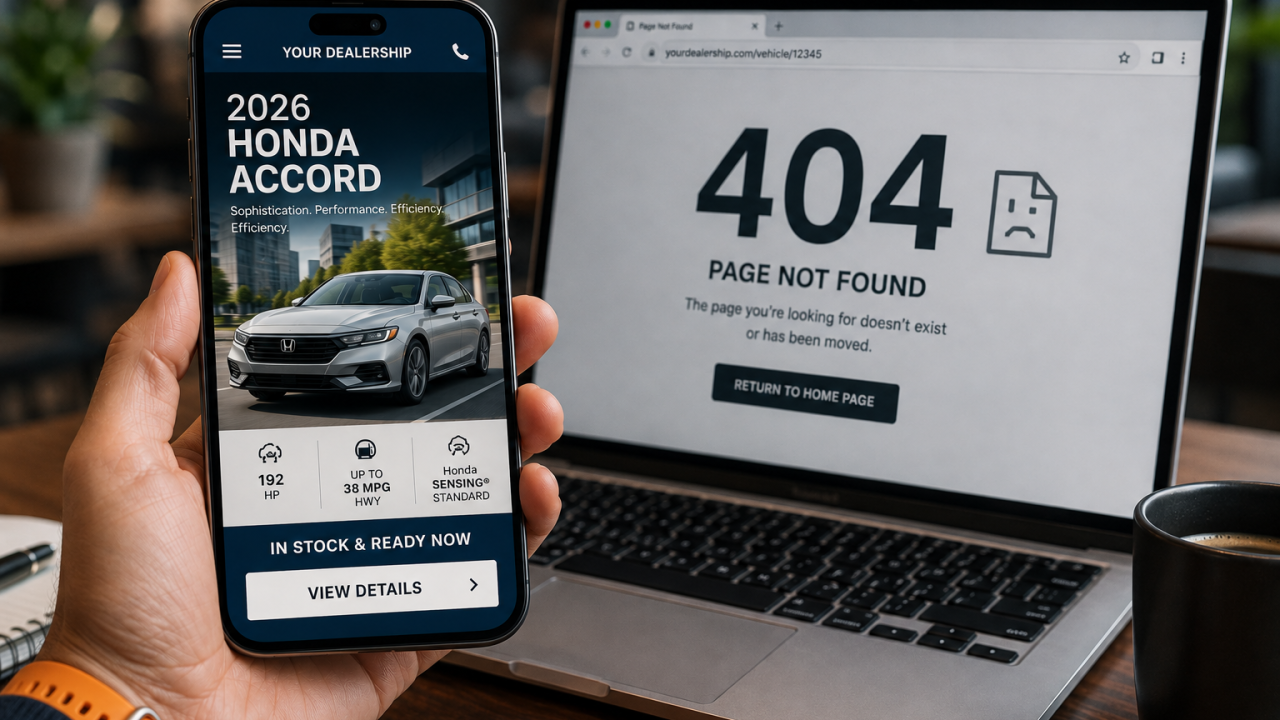
    Consider a shopper who sees an ad for a specific pre-owned SUV. The vehicle, price and mileage get their attention, so they click to learn more. Instead of reaching that vehicle, they hit a broken VDP, discover the vehicle is no longer available or get dumped onto a generic inventory page where they have to start searching all over again.

    The dealership did the hard part. It created interest and earned the shopper’s attention. Then, at the exact moment the shopper demonstrated intent, it introduced friction.

    That’s a very expensive place for the customer experience to break.

    Broken VDPs Waste More Than a Click

    It’s easy to look at a broken VDP as a technical issue that needs to be added to someone’s website task list. But every shopper reaching that page came from somewhere, and when that traffic is paid, every one of those visits has a cost attached to it.

    Search, social, display, video and inventory advertising can all do exactly what they were designed to do and still appear to underperform if the experience after the click falls apart.

    That creates another problem. Poor engagement and abandonment can eventually get blamed on the media strategy. The audience gets changed. The creative gets changed. Budgets move. Campaigns get rebuilt.

    Meanwhile, the actual problem may be sitting on the dealership’s website.

    Before assuming the advertising isn’t working, it’s worth asking whether the shopper actually had a reasonable opportunity to convert.

    Empty SRPs Create the Same Disconnect

    Search results pages can create a similar problem, particularly as dealership advertising becomes more specific.

    This happens all the time…

    If an ad promotes pre-owned trucks under $35,000, the shopper who clicks should arrive somewhere that reflects that message. If the resulting page has very little inventory, contains vehicles outside the advertised criteria or forces the shopper to rebuild the search, the continuity is gone.

    The ad gave the consumer a reason to take the next step. The landing experience immediately weakened that reason.

    This matters even more as targeting and creative improve. Dealers can now build campaigns around specific models, inventory segments, price points, geographies and stages of the buying journey. The advertising experience is becoming increasingly relevant to the individual shopper.

    The destination needs to be just as relevant.

    In fact, the better the advertising gets, the more obvious a bad landing experience becomes.

    Friction Adds Up Quickly

    Consumers don’t care which advertising platform served the ad, which inventory feed powered it or which website provider built the VDP. They only know whether the experience works.

    If they click a vehicle, they expect to see that vehicle. If they click an offer, they expect to find that offer. If the ad promises a certain type of inventory, they expect the next page to show it. Period.

    Every unnecessary click, redirect, reload or new search adds another opportunity for the shopper to leave.

    That’s why landing-page quality should be viewed as part of the advertising experience itself. A dealership can spend heavily to create awareness, generate demand and move a consumer down the funnel, only to introduce unnecessary friction at the moment that consumer finally raises their hand.

    If you’re actually reading this and didn’t just skim the headline, send me a direct message on LinkedIn. I’ll buy your coffee.

    The Entire Journey Needs to Be Monitored

    This becomes more important as automotive advertising becomes increasingly automated.

    Today’s platforms can identify audiences, optimize bids, dynamically advertise inventory, personalize creative and shift investment based on performance. Dealers can run thousands of combinations of vehicles, messages, audiences and landing pages across multiple channels and every profit center.

    That scale creates tremendous opportunity, but it also means problems can scale quickly.

    A broken inventory feed, bad URL structure or website issue may not affect one campaign. It can quietly impact hundreds or thousands of consumer interactions before someone catches it.

    So marketers need to look beyond the traditional campaign dashboard. Are new and used vehicles resolving to live VDPs? Are SRPs populated with the inventory the ad promised? Does pricing remain consistent from the advertisement to the website? Does a service offer lead directly to that offer and an easy way to schedule? Does a parts or accessories ad take the customer to what was actually advertised? Are those experiences working properly on mobile?

    Most importantly, whether you’re advertising new, used, service or parts, can the customer easily get to what you told them was there?

    Don’t Buy More Traffic for a Broken Experience

    When marketing performance falls short, the natural reaction is often to work on the advertising. Spend more. Change the audience. Adjust the targeting. Add another channel. Build better creative.

    Sometimes that’s exactly the right answer.

    But before investing more money to send more shoppers to a dealership website, make sure the traffic you’re already paying for has somewhere effective to go.

    We can talk all day about the coolest creative, the latest AI, proprietary technology, better targeting, more channels and whatever the next big thing in automotive advertising is supposed to be.

    None of it matters if the customer clicks the ad and can’t get to what you advertised.

    You can’t AI your way around a broken customer experience.

    The basics still have to work.

  • Why Accurate Inventory Data Matters in Automotive Advertising

    Why Accurate Inventory Data Matters in Automotive Advertising

    For years, automotive advertising was largely a media-buying exercise. Success depended on choosing the right channels, negotiating rates, and generating enough reach to drive traffic into the showroom.

    Today, advertising performance is increasingly determined long before a campaign ever launches.

    Google, Meta, Vehicle Listing Ads, Connected TV, dynamic creative, and AI-driven bidding platforms all rely on the same foundation: accurate, complete, and timely inventory data. Every automated optimization, every vehicle recommendation, and every dynamic advertisement begin with this key piece of information. When that information is incomplete or inaccurate, the entire marketing ecosystem becomes less effective.

    The result is an invisible source of wasted advertising spend that many dealers never identify.

    Accurate Inventory Data Creates Better Advertising Signals

    Consumers expect digital shopping experiences to reflect reality. They assume the vehicle featured in an advertisement is still available, that pricing is current, that photos accurately represent the vehicle, and that the information on the landing page matches what they saw in the ad. When those expectations aren’t met, confidence erodes quickly.

    Google has consistently demonstrated that even small amounts of friction during the online shopping journey reduce engagement and conversion rates, making data quality just as important as media quality.

    The impact extends well beyond customer experience.

    How Inventory Data Improves Dealership Advertising Performance

    Modern advertising platforms optimize continuously using inventory feeds. Google’s Vehicle Listing Ads, Performance Max campaigns, Meta’s automotive inventory ads, and dynamic creative platforms all evaluate vehicle attributes such as pricing, availability, images, trim levels, equipment, and merchandising quality when determining which vehicles to promote and to whom. Better inventory data doesn’t simply improve accuracy. It improves the algorithms by making thousands of advertising decisions every day.

    Google has repeatedly reported that richer product feeds containing complete attributes, higher-quality imagery, accurate pricing, and detailed descriptions improve campaign performance across its commerce ecosystem. While those studies span multiple retail categories, the same principle applies directly to automotive. Better inventory data creates stronger relevance, higher engagement, and more qualified traffic because advertising platforms have more confidence in what they are promoting.

    Research from Cox Automotive reinforces the importance of merchandising quality. Vehicle Detail Pages remain among the most influential assets in the digital purchase journey, with shoppers spending significant time comparing photos, pricing, features, and equipment before deciding whether to contact a dealership. Missing images, incomplete specifications, inconsistent pricing, or delayed inventory updates introduce unnecessary friction at one of the most important decision points in the buying process.

    Why AI-Powered Automotive Advertising Depends on Better Data

    The challenge is becoming even more significant as artificial intelligence assumes a larger role in automotive advertising. AI-powered bidding, predictive modeling, audience segmentation, and dynamic creative all depend on structured, reliable data to make intelligent decisions.

    Unlike a human marketer, and without significant intervention, AI does not recognize that an inventory feed contains errors. It simply optimizes around the information it receives. Poor data doesn’t slow automation—it scales its inefficiencies.

    Inventory Management Is Now a Strategic Marketing Function

    This is why inventory management should no longer be viewed as an operational responsibility alone. It has become a strategic marketing function. Every accurate photo, equipment package, price update, incentive, and vehicle description strengthens the quality of the data flowing into the advertising platforms responsible for generating demand.

    Dealerships often ask how to improve advertising performance through better creative, stronger targeting, or larger budgets. Those investments certainly matter, but they become exponentially more effective when supported by accurate inventory data. In many cases, improving the underlying data feeding an advertising platform can generate greater efficiency than increasing media spend because every optimization algorithm has better information from which to learn.

    As automotive marketing becomes increasingly automated, competitive advantage will belong to dealerships that invest not only in better media strategies, but also in better marketing infrastructure. Inventory data is no longer simply a merchandising asset. It is the intelligence layer powering every modern advertising platform.

    The Future of Automotive Advertising Is Data-Driven

    The future of automotive advertising will not be won solely by who buys the most media. It will be won by those providing the highest-quality data to the technologies making millions of optimization decisions every day.

    In an AI-driven marketplace, inventory is no longer just what a dealership sells.

    It is one of its most valuable competitive assets.

  • Why Hyper-Local Advertising Wins More Shoppers

    Why Hyper-Local Advertising Wins More Shoppers

    Last week, we were reviewing a new set of ad creative with a dealership. One of the images featured a vehicle driving along a suburban road that looked strikingly familiar.

    The client looked at it for a moment, smiled, and said,

    “That literally looks like it’s a few streets behind our store.”

    It wasn’t.

    But that comment perfectly captured something many dealerships overlook.

    The best advertising doesn’t just showcase the right vehicle or the right offer. It feels like it belongs. When creative reflects the roads shoppers drive, the neighborhoods they recognize, and the environment they experience every day, it creates an immediate sense of familiarity. That familiarity builds credibility long before anyone reads the headline or clicks the ad.

    For years, localization has been viewed primarily as a media strategy. Dealers talk about targeting ZIP codes, adjusting radiuses, or focusing spend around specific markets. Those are important decisions, but they’re only part of the equation.

    The creative itself should be just as localized as the audience you’re trying to reach.

    Consumers Notice More Than You Think

    Advertising works best when it feels authentic.

    Research published in Computers in Human Behavior found that

    advertising aligned with a consumer’s geographic environment is perceived as significantly more relevant than advertising that feels disconnected from where they live.

    Relevance increases attention, and attention is the first step toward action.

    That may sound obvious, but it’s surprising how often dealerships unintentionally create the opposite effect.

    A dealership in Southern California shouldn’t feature vehicles driving through fresh snow. A retailer in upstate New York probably shouldn’t showcase palm trees swaying in the background. A desert highway feels out of place for a dealer in coastal Florida, just as a beachfront scene doesn’t belong in rural Kansas.

    Most shoppers will never stop and think, “Those palm trees don’t belong.” They don’t have to. Their brain notices before they consciously do. The advertisement simply feels less believable.

    When creative doesn’t reflect the shopper’s world, it becomes easier to dismiss because it feels like it could have been created for any dealership in America.

    Local Means More Than Geography

    Hyper-Local creative isn’t about recreating a specific street corner or inserting a famous landmark into every advertisement.

    It’s about reflecting the character of the community.

    That includes the weather, the landscape, the roads, the architecture, the season, and even the lifestyle people associate with living there. A truck campaign in Texas should feel different than one in downtown Chicago. A family SUV driving through the mountains of Colorado tells a different story than one cruising the coastline of Southern California. Neither approach is better. They’re simply speaking to different audiences.

    That’s why our client’s comment stood out.

    They weren’t impressed because we had perfectly recreated their neighborhood. They were impressed because the creative felt familiar. It looked like the vehicle could have been photographed minutes from their showroom. That subtle sense of authenticity immediately made the advertising feel more believable.

    Consumers may not consciously recognize every local detail, but they absolutely recognize when something feels genuine.

    One Version No Longer Fits Every Market

    For decades, dealerships had little choice but to create one version of everything.

    • One television commercial.
    • One photoshoot.
    • One collection of images.

    Those same assets were expected to work in every campaign regardless of geography, season, or audience because creating dozens of variations simply wasn’t practical. Production was expensive. Revisions took time. Every additional version required more people, more approvals, and more budget. Today, that limitation has largely disappeared.

    AI-assisted creative production, when done correctly, makes it possible to produce localized imagery at a scale that would have been nearly impossible just a few years ago. Backgrounds can reflect local environments. Seasonal imagery can change throughout the year. Creative can adapt to regional inventory, weather, and promotions without starting from scratch every time.

    The conversation has shifted from, “Can we afford multiple versions?” to, “Why would every market receive the same creative?”

    That’s a very different way of thinking about dealership advertising.

    Relevance Is Becoming the Competitive Advantage

    Consumers are exposed to thousands of ads every day. Most disappear almost as quickly as they’re seen because they feel generic.

    The dealerships earning attention aren’t always spending the most. They’re creating ads that feel like they belong.

    That doesn’t require flashy production or elaborate storytelling. Sometimes it’s as simple as showing the right vehicle on the right road, in the right season, surrounded by an environment shoppers instantly recognize.

    I keep coming back to our client’s reaction.

    “That literally looks like it’s a few streets behind our store.”

    And that is exactly the point.

    The goal isn’t to recreate a neighborhood. It’s to create ads that feel like they were made for the people who live there. When shoppers can picture that vehicle on the roads they drive every day, the creative becomes more believable, the dealership feels more familiar, and the advertising becomes more effective.

    Sometimes the smallest creative decisions create the biggest competitive advantage.

  • The New Automotive Advertising Playbook

    The New Automotive Advertising Playbook

    Why Omnichannel Advertising Requires Omnicreative

    Automotive advertising has entered a new era, but much of the industry is still using an old playbook.

    For decades, success was built around creating one compelling television commercial, one monthly offer, and distributing that message as broadly as possible. Today’s consumer journey makes that approach increasingly ineffective. Buyers no longer move through a linear sales funnel, and they don’t consume media through a single channel. They discover vehicles through search, social media, streaming video, Connected TV, podcasts, websites, email, and dealership visits, often moving between those touchpoints dozens of times before making a purchase.

    The expectation has changed. Consumers no longer expect to see the same message everywhere. They expect every interaction to be relevant to where they are on their buying journey.

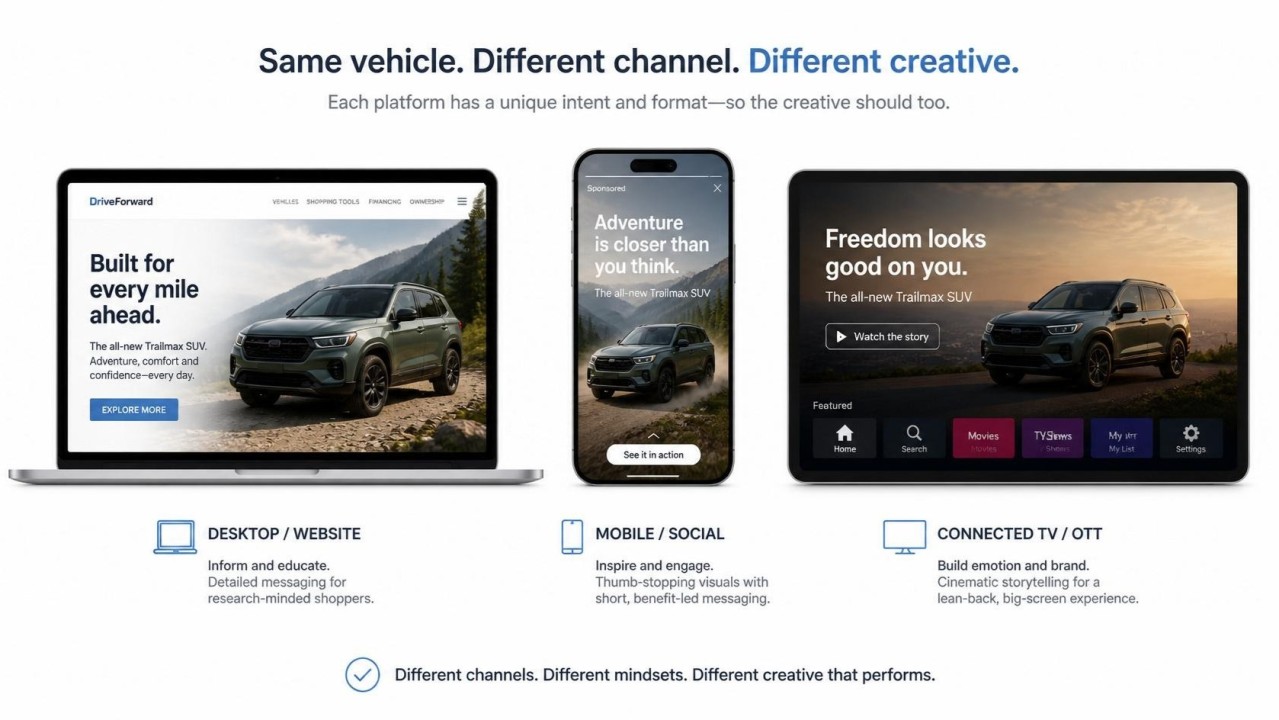
    Research from Google has shown that shoppers move unpredictably between channels, using each platform for a different purpose. Someone watching a YouTube vehicle review is looking for education. A shopper searching for “best lease deals near me” is looking for immediate action. A Facebook user may simply be discovering a vehicle they hadn’t previously considered. Delivering identical creative across each of those environments ignores the context in which consumers engage.

    That context matters because relevance consistently outperforms repetition.

    McKinsey has found that companies leading in personalization generate 40% more revenue from those efforts than their competitors, while the vast majority of consumers say they are more likely to purchase from brands that provide relevant experiences. Likewise, Google and Meta continue to emphasize that creative quality has become one of the largest drivers of advertising performance, often having a greater impact than audience targeting alone. Better targeting may determine who sees your message, but better creative determines whether that message is remembered.

    For automotive retailers, personalization extends well beyond inserting a shopper’s name into an email. Every vehicle category represents a different purchase decision. EV shoppers care about charging, range, and incentives. Truck buyers evaluate capability and towing. Luxury buyers are influenced by craftsmanship, technology, and ownership experience. Service customers value convenience, trust, and transparency. Treating these audiences with the same monthly sales message creates generic advertising that resonates with very few shoppers.

    The same principle applies across the buying journey. First-time visitors need inspiration and education. Returning shoppers need inventory updates, payment options, or reasons to act. Customers approaching lease maturity require entirely different messaging than owners simply researching future possibilities. Modern advertising platforms can now adapt creative dynamically based on audience behavior, CRM data, vehicle availability, market conditions, and predictive buying signals. Technology exists to make every impression more relevant than the last.

    Perhaps the biggest opportunity for dealerships, however, is something national advertisers simply cannot replicate: hyper-local creative.

    Automotive retail has always been local, yet much of today’s advertising still feels generic. Consumers respond to familiarity. They want to see the roads they drive every day, the neighborhoods they recognize, local landmarks, regional events, seasonal weather, and inventory that actually exists on the dealer’s lot. A truck campaign in rural Texas should not look or sound like one running in downtown Chicago. An EV campaign in Southern California should differ dramatically from one in northern Michigan during the winter. Local relevance builds authenticity, trust, and credibility in ways that templated creative never can.

    This is where artificial intelligence is beginning to reshape automotive marketing. Dealers can now produce localized creative at scale, generating versions tailored to specific markets, audiences, inventory levels, weather conditions, incentives, and media channels without sacrificing brand consistency. Instead of one campaign serving every shopper, a dealership can deploy hundreds of creative variations, each designed to match a specific consumer context.

    The business case for this approach is compelling. Google has reported that advertisers using responsive and dynamically optimized creative often achieve meaningful improvements in conversions because messaging better aligns with consumer intent. Dynamic Creative Optimization (DCO) studies from multiple ad technology providers have also demonstrated higher click-through rates and stronger engagement when creative adapts to audience signals rather than relying on static assets.

    This represents a fundamental shift in how competitive advantage is created. For years, marketers focused primarily on buying better media. Increasingly, the differentiator is not where you advertise, but what consumers see when they get there.

    The dealerships that will lead over the next decade won’t necessarily have the largest advertising budgets. They’ll have the most adaptable creative strategy. They’ll understand that omnichannel advertising requires omnichannel creative, where every message reflects the channel, the vehicle, the shopper’s intent, and the local market.

    In today’s automotive landscape, creative is no longer just the packaging around an advertising campaign.

    It is one of the most important drivers of its performance.

  • How AI Is Transforming Dealership Video Advertising : The End of One-Size-Fits-All Dealership Video

    How AI Is Transforming Dealership Video Advertising : The End of One-Size-Fits-All Dealership Video

    For years, effective dealership video advertising was not limited by creativity. It was limited by the budget and time required to continually produce relevant campaigns.

    If you had the resources, you could hire a production company, spend a day filming, and produce a library of polished commercials. If you had an in-house creative team, you could refresh those videos throughout the year as inventory changed, incentives evolved, and new campaigns launched.

    Most dealerships couldn’t.

    Instead, they relied on a handful of videos to carry every campaign. One commercial promoted multiple models. One message served every audience. The same creative appeared across search, social, YouTube, connected TV, and display regardless of who was watching.

    It wasn’t because marketers believed one-size-fits-all advertising worked. It was because creating anything else wasn’t practical.

    Today, that’s changed.

    The Rules of Video Advertising Have Changed

    The way consumers shop for vehicles has changed dramatically over the last decade.

    They research online, compare models across multiple brands, watch review videos, browse inventory, read customer reviews, and move between devices before ever speaking with a dealership. And advertising evolved alongside them.

    Today’s campaigns can target shoppers based on geography, online behavior, vehicle interest, previous website visits, household demographics, and dozens of other signals.

    Yet many dealerships still deliver the same creative to every one of those audiences.

    Dealerships have become remarkably sophisticated at deciding who should see an ad. We’ve spent far less time deciding what they should see.

    That disconnect is becoming one of the biggest limitations in dealership advertising.

    Relevance Is the New Competitive Advantage

    • A shopper researching a heavy-duty truck doesn’t think like someone shopping for their teenager’s first vehicle.
    • A customer comparing lease offers isn’t looking for the same information as someone searching for a certified pre-owned SUV.
    • Someone who has visited your website three times doesn’t need the same introduction as someone seeing your dealership for the first time.

    These aren’t small differences. They’re completely different conversations. The most effective advertising reflects those differences. Yet too often, they’re all being served the same creative.

    Not with a single commercial trying to appeal to everyone, but with creative designed for the audience, the vehicle, the offer, and the moment. For years, that level of relevance was simply too expensive and more importantly too time-consuming for most dealerships to maintain. Now it isn’t.

    AI Doesn’t Replace Creativity. It Removes the Bottleneck.

    One of the biggest misconceptions about AI is that it’s replacing marketers.

    It isn’t.

    Without guidance or prompting, AI doesn’t know which models you need to move. It doesn’t understand your local market. It doesn’t decide how your dealership should be positioned or what message will resonate with your customers.

    People do that.

    What AI changes is execution.

    Instead of spending days or weeks creating dozens of versions of the same campaign, dealerships can now produce relevant video at a speed and scale that simply wasn’t possible before. That doesn’t mean sacrificing creativity.

    It means removing repetitive production work so creative teams can spend more time doing what only they can do: developing better ideas, stronger messaging, and more effective campaigns.

    The strategy remains human. The execution becomes dramatically more efficient.

    A Capability Once Reserved for the Largest Dealer Groups

    Not long ago, maintaining a steady stream of fresh video required significant resources.

    Large dealer groups could afford dedicated creative teams, frequent production schedules, and agencies capable of producing new assets throughout the year.

    Most dealerships had to make a handful of videos last as long as possible.

    Artificial intelligence is changing that equation.

    Today, a single rooftop has access to capabilities that were once available only to organizations with much larger budgets. Existing creative, inventory, offers, and dealership branding can now be transformed into fresh, campaign-ready video without rebuilding every asset from the ground up.

    That levels the playing field.

    It allows single point dealerships and smaller groups to compete with the same consistency and agility as much larger organizations.

    Where Strategy Wins

    More video isn’t the goal. More relevant video is.

    That’s an important distinction.

    Producing hundreds of generic videos doesn’t create a competitive advantage.

    Producing the right video for the right shopper at the right stage of the buying journey does.

    That’s why strategy matters more than ever.

    The dealerships that succeed won’t be the ones using AI to replace creative thinking. They’ll be the ones using AI to execute smarter strategies more consistently than their competitors.

    At Proficy Digital, AI has become an extension of our creative process, not a replacement for it. Our platform continuously produces and refreshes video and image advertising using current inventory, active offers, dealership branding, and channel-specific formats. Every asset begins with human strategy and creative direction, then uses AI to scale execution across campaigns, audiences, and channels.

    That allows us to keep creative current as inventory changes, incentives evolve, and campaigns shift, without starting from scratch every time.

    The era of one-size-fits-all dealership video is ending. Not because creativity matters less.

    Because dealerships finally have the ability to deliver the right message to the right shopper at the right time.

    That isn’t just better video. It’s better advertising.