Blog

  • AI Is Everywhere in Automotive Marketing. How Much of It Is Noise?

    AI Is Everywhere in Automotive Marketing. How Much of It Is Noise?

    A quick Google search for “automotive AI” yields hundreds of results.

    • Chatbots.
    • Lead response tools.
    • Service scheduling assistants.
    • Conversational sales agents.

    Most of the AI currently being marketed to dealerships falls into one of two categories:

    Conversational AI or agentic AI.

    These tools are designed to interact with customers. They answer questions, schedule appointments, respond to leads, and help sales teams manage communication more efficiently.

    There is real value in that. Responding faster to leads improves conversion. Better customer interaction improves experience. But I would argue that is just one piece of the puzzle.

    Because while the industry is focused on AI answering questions from shoppers, very little attention has been paid to something far more impactful:

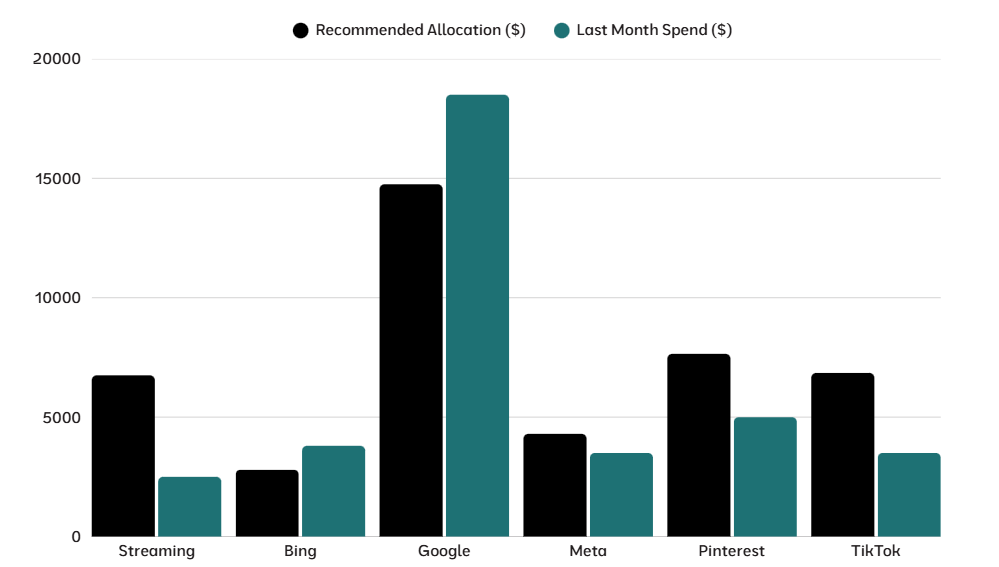
    Using AI to decide how advertising dollars should move.

    Another, Possibly Bigger Opportunity for AI

    While conversational and agentic AI focus on customer interaction, a much larger opportunity exists on the decision-making side of marketing.

    Every dealership today is generating an enormous amount of data across its advertising ecosystem:

    • Search behavior
    • Inventory shifts
    • Audience engagement
    • Creative performance
    • Geographic demand patterns
    • Historical sales cycles

    Taken together, these signals represent millions of potential data points that influence advertising performance. Yet most advertising decisions are still made using a handful of reports and human interpretation. Most often, budget shifts happen monthly. Campaign changes happen periodically. Optimization happens after performance is already visible.

    In a market that moves as quickly as automotive retail, that approach creates lag.

    What if Advertising Worked More Like Day Trading?

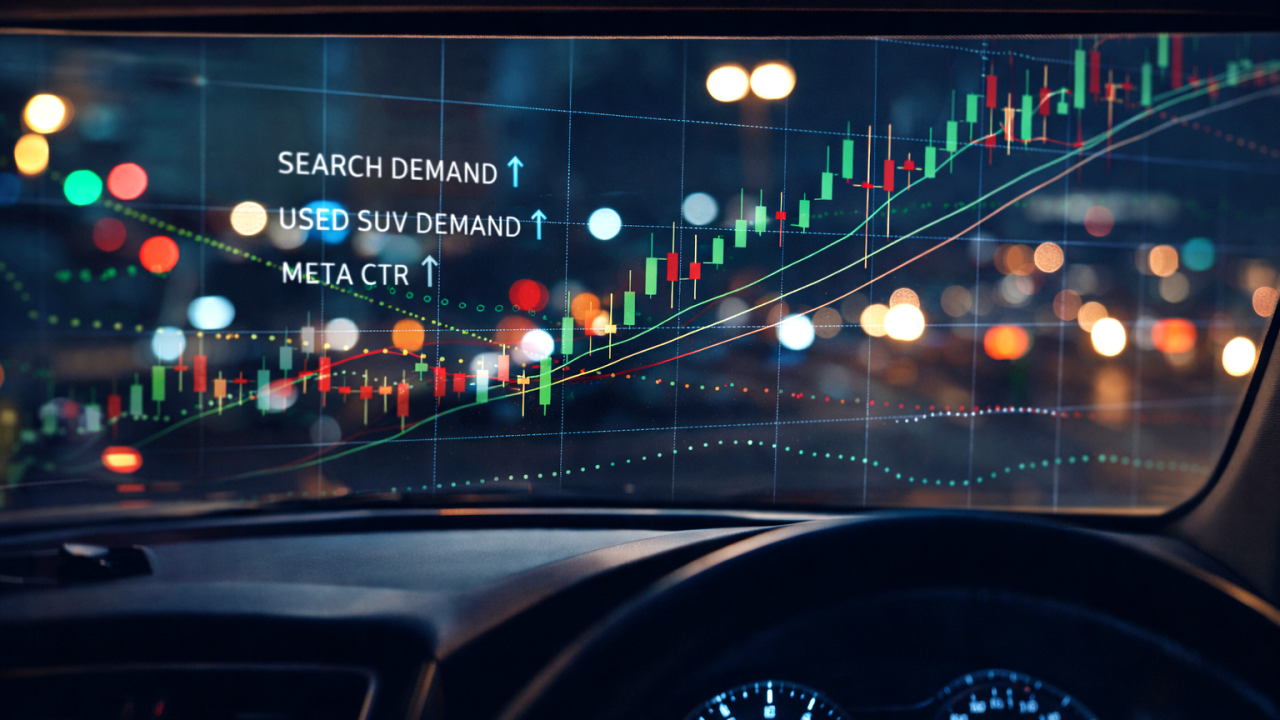
    A better way to think about modern advertising could be through the lens of financial markets. Day traders evaluate enormous volumes of signals continuously; Price movement, Market momentum, Volume changes , External news, Historical patterns.

    Capital moves dynamically based on probability.

    Modern advertising should work the same way.

    AI systems can evaluate signals such as; Search demand trends, Inventory availability, Audience behavior patterns, Creative engagement signals, Geographic performance shifts

    Investment can then move dynamically toward the highest probability of creating incremental shoppers or generating sales or service demand.

    Humans Still Set the Strategy

    None of this removes the importance of human strategy.

    AI can analyze signals and execute decisions quickly, but it still requires clear direction.

    Humans define the business priorities:

    • Should the focus be market share growth or used vehicle velocity?
    • Should the strategy prioritize conquesting competitors or defending the core market
    • Should fixed ops retention become a primary growth driver?

    Those decisions require both experience and an understanding of dealership operations.

    Once the strategy is defined, AI becomes the execution engine.

    The Future of the Automotive Digital Agency

    This shift will change the role of the automotive digital agency.

    Agencies will no longer be defined simply by their ability to manage campaigns or produce creative.

    The real value will come from building systems that can:

    • Process massive volumes of data
    • Identify patterns humans cannot see
    • Allocate budget dynamically
    • Continuously improve performance

    In other words, the future agency will operate more like a decision engine than a campaign manager.

    The Real Question, IMO…

    The real question is not whether AI belongs in automotive marketing.

    That answer is already clear.

    The real question is where it could be applied.

    Conversational and agentic AI can improve speed, responsiveness, and customer experience. That matters. Faster responses to shoppers can absolutely improve conversion. But there may be an equally important opportunity emerging elsewhere.

    Should AI focus only on answering questions from shoppers?

    Or should it also help decide something far more consequential:

    Where millions of advertising dollars should move next?

    Because if AI can both improve customer conversations and guide smarter marketing investment, the impact on dealership performance could be far greater than either one alone. And that may be where the next real evolution of automotive AI begins.

  • The Jordan Standard: What Performance Actually Looks Like in Modern Marketing

    The Jordan Standard: What Performance Actually Looks Like in Modern Marketing

    Our CEO is a bit of a sneakerhead. Serious about it and loves his Air Jordans.

    Not because they are trendy. Not because of resale value. Not because of nostalgia.

    He likes them for the same reason they became iconic in the first place. They were built around performance, and the market validated it over time.

    Air Jordans did not become iconic because of colorways.

    They became iconic because of what Michael Jordan did in them. Championships. Clutch moments. Relentless consistency. The product earned its reputation because the results backed it up.

    Marketing should work the same way.


    Most agencies sell creative, impressions, or platform access. Few sell measurable, incremental growth.

    At Proficy Digital, we are not interested in marketing that only looks impressive in a deck. We are focused on performance that moves market share and profitability.

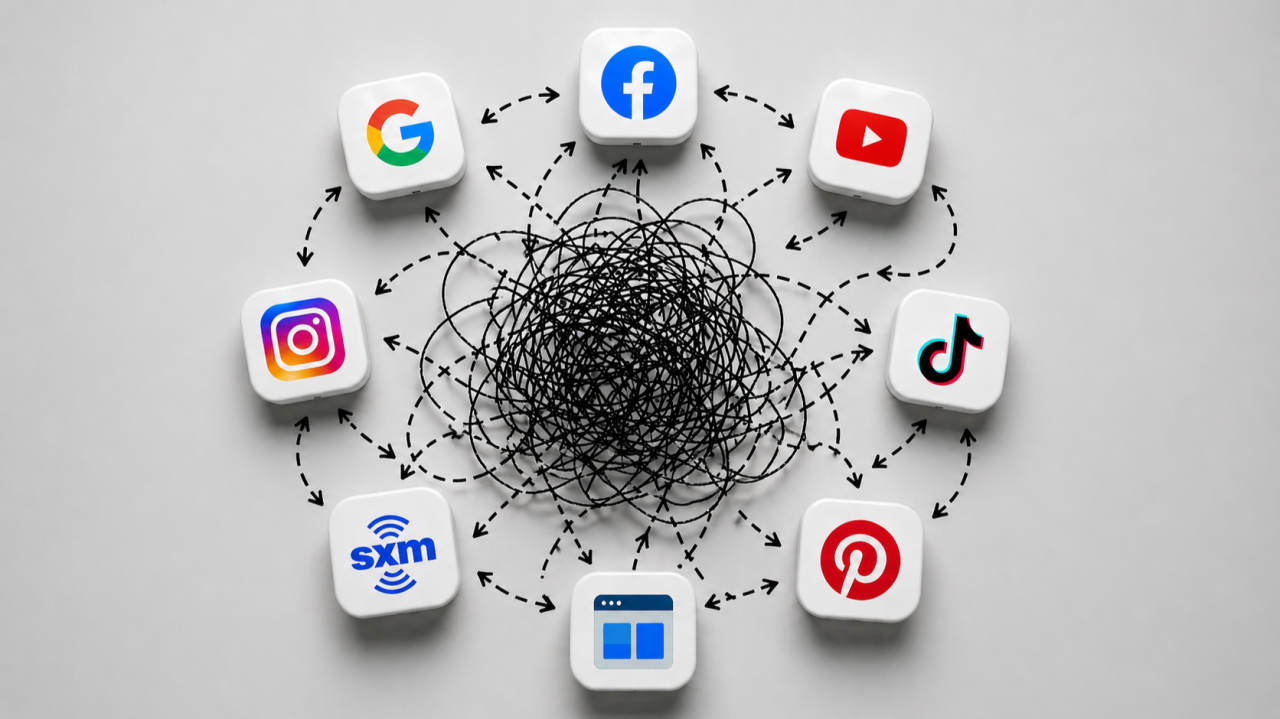
    Most dealerships today are running fragmented efforts. One vendor handles search. Another handles paid social. Someone else may be doing streaming. A different partner might be producing creative. Third party listings live in their own world. Data sits in separate silos. Reporting happens in the rearview.

    That is vendor stacking. Not strategy.

    You would not expect stitched together sneakers to perform in the Finals. Yet dealers expect peak growth from disconnected marketing systems.


    Behind Air Jordan was Nike. Product evolution. Data. Tight control. Constant iteration. A system built to support elite performance.

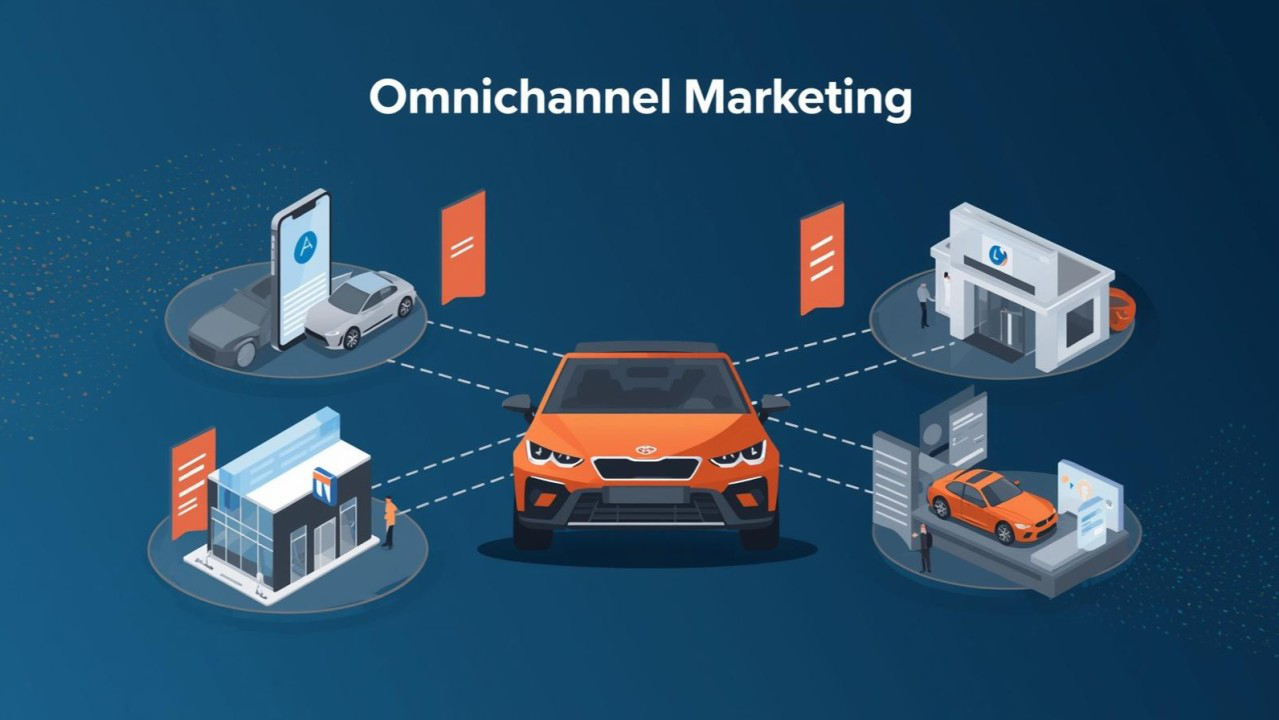
    Behind Proficy is a proprietary AI driven platform and an integrated omnichannel strategy that connects Awareness, Consideration, Intent, and Urgency.  Every signal feeds optimization. Investment shifts based on predictive insight, not hindsight reporting.

    Our team doesn’t ask what happened last month. We influence what happens next month (and the month after).

    More spend does not create leverage. More vendors do not create clarity.

    Better systems create advantage.

    If your marketing plan looks roughly the same as last year, what exactly improves?

    Air Jordans were never built for everyone. They were built for competitors.

    The same applies here.

  • The Automotive Buying Journey Has Fundamentally Changed. Most Marketing Is Still Late.

    The Automotive Buying Journey Has Fundamentally Changed. Most Marketing Is Still Late.

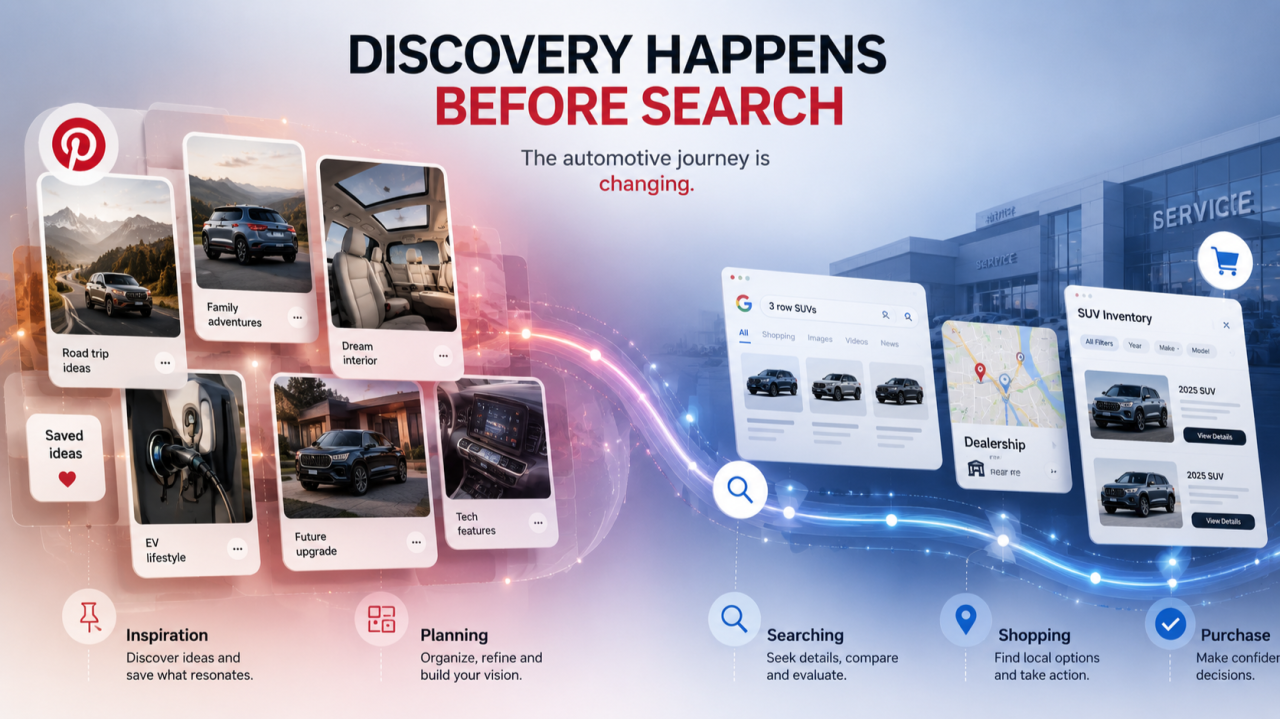
    Do not mistake, shoppers are researching earlier, consuming more video, and forming preferences long before a lead form is filled out or a search query is typed.

    According to Google, more than 90 percent of automotive buyers say online video influences their purchase decision.

    That influence happens upstream, during research and consideration, not at the point of conversion.

    Yet most dealer marketing dollars are still concentrated at the bottom of the funnel.

    That disconnect is why marketing costs are rising while predictability declines.

    TikTok reports that automotive content drives roughly 2x higher ad recall, with discovery happening passively rather than through active intent. Similarly, Pinterest has consistently shown that automotive intenders plan purchases weeks or months before submitting a lead, saving and revisiting content long before entering a traditional funnel.

    Behavior moved earlier. But, spend largely did not.

    Instead, most strategies still try to capture demand after the decision is already forming (or has been made). Search is asked to be the growth engine even though it primarily captures intent that already exists. Social is treated as lightweight awareness. Video is layered in without a defined role.

    This outcome is predictable.

    CPMs rise. CPCs rise. Cost per lead climbs. At the same time, lead quality becomes a real problem. That is not a platform problem. It’s a timing problem.

    Most investment still chases outcomes instead of creating them.

    This feeds one of the most damaging beliefs in automotive marketing.

    More leads do not create better outcomes.

    When volume becomes the objective, cost and risk increase while quality becomes inconsistent. Sales teams experience it first through lead fatigue, uneven close rates, and declining confidence. The blame moves downstream to the CRM, the BDC, or the consumer, while the real issue sits upstream.

    If demand is not shaped early, captured intent becomes non-existent. Performance becomes reactive and unpredictable.

    The dealers seeing the most stability today are not chasing every click. They are communicating where shoppers actually spend time. They influence decisions earlier using content designed for awareness and consideration. They refresh creative at the pace of attention, not at the pace of monthly reports.

    Each channel has a job. Each stage supports the next.

    That creates leverage.

    Not just volume. Certainty.

    The buying journey changed.

    If a strategy is still built to win the final click instead of influence the earlier decision, rising costs are not surprising. They are unavoidable.

  • As 2025 Comes to a Close: What Dealers Should Rethink for 2026

    As 2025 Comes to a Close: What Dealers Should Rethink for 2026

    As 2025 comes to a close, most dealerships are already looking ahead to budgets, plans, and priorities for 2026. That is the right instinct. But the bigger question is not what to spend next year. It is what to change.

    The automotive retail landscape did not shift overnight in 2025. It quietly exposed what is no longer working.

    • Fragmented marketing.
    • Overreliance on last-click reporting.
    • Channel decisions driven by habit instead of outcomes.

    Dealers who treat 2026 as a continuation of 2025 will fall behind those who use it as a reset.

    Rethink how you define “strategy.”

    Running ads on Meta, Google, streaming, and YouTube does not equal a strategy. It equals activity.

    In 2026, winning dealers will stop asking “What channels should we be on?” and start asking “What role does each channel play in the sales funnel?”

    Some channels should create demand. Others should educate and qualify. Others should capture intent. When every platform is asked to do everything, efficiency collapses. An integrated omnichannel strategy assigns one clear job to each channel and eliminates overlap, waste, and noise.

    Move from reactive reporting to predictive planning.

    Most marketing decisions are still made by looking backward. Last month’s results. Last quarter’s cost per lead. Last year’s sales mix.

    Guess what? The market does not care.

    2026 needs to be the year more dealers plan based on what is likely to happen, not what already did. Predictive modeling and forecasting are not about guessing the future. They are about reducing risk, allocating smarter, and avoiding late reactions when conditions change.

    Rebalance the funnel, especially at the top.

    When sales soften, most stores pull back on awareness and push harder on lower funnel tactics. It feels safe. It rarely works.

    Dealers who grew in 2025 did not just capture demand. They created it earlier. Streaming, video, and social matter more when shoppers take longer to convert and competition tightens.

    Starving the top of the funnel shows up months later in the showroom. 2026 should be about feeding it intentionally.

    2026 will not reward dealerships that spend more. It will reward those willing to change what no longer works.

    Treat creative as a performance lever, not a checkbox.

    Creative is still one of the most underutilized levers in automotive marketing.

    Static ads reused everywhere. Outdated incentives. Video treated as optional.

    In 2026, creative needs to be dynamic, sequential, and aligned to funnel stage. Awareness creative should not look like intent creative. The same shopper should not see the same message over and over and over as they move closer to purchase.

    Creative should adapt in real time, because performance does.

    Elevate fixed ops from support to strategy.

    Sales gets the attention. Fixed ops often delivers the profit.

    More dealers are realizing that service is not just about retention. It is about acquisition, relationship building, and long-term value. Smarter marketing programs in 2026 will invest intentionally in service growth, conquesting non-brand owners, and building loyalty earlier in the customer lifecycle.

    Marketing should support all dealership profit centers, not just vehicle sales.

    2026 will not reward dealers who simply spend more. It will reward those who think differently.

    Those willing to realign strategy, rebalance the funnel, and modernize how decisions are made will separate quickly from the rest of the market.

    Cheers to a successful new year!

  • Game Changer Series 2025 – Grow Market Share & ROI with a Predictive Omnichannel Strategy

    Dealers do not have a visibility problem. They have an alignment, measurement, and risk control problem. This Game Changer Holiday Series livestream breaks down why being everywhere is not a strategy, what real omnichannel execution looks like, and how AI, predictive modeling, and better metrics help dealers reduce risk and spend with confidence.

  • Smarter Spend, Better Results – Inside Proficy Digital’s Dealer Playbook

    Smarter Spend, Better Results – Inside Proficy Digital’s Dealer Playbook

    Our CEO and co-founder, David Raminick, and our VP of Sales, Justin Friend, were recently featured on the Healey Brothers podcast with host Jay Healey. In the episode, they walked through how Proficy Digital approaches omni-channel marketing very differently from the typical “be-everywhere-and-hope” strategy. They explained that our platform was built with AI and machine learning as the first line of code, and that we use massive volumes of website traffic data to forecast demand 90 days out and shift spend between upper-funnel and lower-funnel channels based on where shoppers actually are in their journey. The focus of the episode is on efficiency, profitability, and incremental sales/market share, not just impressions or vanity metrics. Proficy Digital is focused on tailoring strategy store-by-store and market-by-market instead of using generic playbooks.

    Learn about how true omni-channel is more than just “being present” on Google and Meta. It’s about having integrated messaging across channels like search, social, video, Pinterest, and OTT; using creative that reflects the local community and the dealer’s brand; and maintaining a strong video strategy with fast turnaround on incentives and offers. Platforms like Pinterest, Instagram, and TikTok are now effectively search engines, dealers need to stop relying on gut feel and month-to-month reaction, and how our proposals use data-driven budget ranges instead of arbitrary numbers.

  • EP 1 –  Dealers Can’t Rely on Google and Facebook Alone

    EP 1 – Dealers Can’t Rely on Google and Facebook Alone

    Dealers, do you want to reach every shopper, not just the ones willing to buy? In the first episode of Modern Automotive Marketing, we learn the importance of true omnichannel, full-funnel, modern automotive marketing in today’s modern landscape and why dealerships can no longer rely solely on Google and Facebook for sales. Host Jason Harris and Justin Friend, VP of Sales at Proficy Digital, discuss how modern buyers finish almost 90% of their research before submitting a lead. Dealers who target only bottom shoppers are fighting over the same 3% while ignoring the 97% of buyers who are still investigating, learning, and forming opinions about brands.

    Justin describes how Proficy Digital employs a predictive, AI-driven model that delivers customized content across platforms like Amazon, TikTok, streaming services, and more, eliminating wasteful spending and making real-time budget adjustments. This episode highlights opportunities and issues for dealers where they can grow retention and profit. By adopting these modern, full-funnel strategies, dealers can secure an incremental market share.

  • EP 2 – Creative That Converts-Why Speed and Relevance Win

    EP 2 – Creative That Converts-Why Speed and Relevance Win

    For dealers looking to modernize their approach, hear this message: creative must be fast, relevant, and tailored to your audience, or you’re leaving opportunities on the table.
    In this episode of Modern Automotive Marketing, host Jason Harris reconnects with guest Justin Friend of Proficy Digital to discuss why speed and relevance in creative are essential for dealership success. Join us as they break down how slow, generic creative weakens campaigns and define “creative that converts” as delivering an emotionally resonant, personalized content across every stage of the buyer’s journey.

    While OEM creative can create a helpful halo effect, Jason and Justin stress that real impact comes from pairing localized, dealer-specific messaging that makes the shoppers feel heard and understood. Effective creative speaks directly to the customer’s needs, whether that’s family safety features or towing capacity; it adjusts to real-time digital signals.

    Learn how Proficy Digital solves the biggest challenge of keeping pace with constantly shifting incentives and inventories by implementing an automated system capable of producing up to 20,000 videos a day in every format, allowing dealers to deploy creative, timely and effectively, rather than waiting days or weeks for traditional agencies, ensuring they’re never “out of market.”

  • EP 3 – Is Your Marketing Fragmented or Integrated?

    EP 3 – Is Your Marketing Fragmented or Integrated?

    Is your dealership’s marketing working together or working against you? In this episode of Modern Automotive Marketing, join host Jason Harris as he sits down with David and Justin Friend of Proficy Digital as they unpack the difference between fragmented marketing and a truly integrated omnichannel strategy.

    Learn from David how Proficy Digital was founded to solve the inefficiencies in the vendor/agency space after his experience in two failed startups provided critical lessons. The company was built from the “first line of code” using AI, machine learning, and statistical models to be a forward-looking and predictive, focusing relentlessly on profitability (hence the spelling of “Proficy”) for dealers.

    The conversation reveals that more than 90% of dealership marketing is fragmented with disconnected campaigns, multiple agencies, and misallocated budgets that chase channels instead of results. David and Justin break down how Proficy’s predictive, profit-focused approach shifts dealers away from arbitrary multi-channel checkboxes into a unified omnichannel system where every dollar works together.

  • Are You Fishing Blind? Why Predictive AI Marketing Knows Where the Buyers Are

    Are You Fishing Blind? Why Predictive AI Marketing Knows Where the Buyers Are

    I love to fish. What I love even more is to catch fish.

    What if AI could guide you to the exact spot where the fish are, tell you the best time to cast, and even recommend the right bait? You wouldn’t be fishing blindly, you’d be fishing with precision.

    Maybe a wild analogy, but that’s exactly what predictive omnichannel marketing does for dealerships.

    Fishing Without a Map

    Traditional marketing is like taking a small boat out into the ocean without sonar. You cast in one spot, maybe run a few lines, and hope the fish are nearby. Sometimes you get lucky, but more often the fish are swimming somewhere else.

    AI as Sonar and Guide

    Predictive AI scans the waters across 12+ channels: search, social, video, OTT, display, streaming, and more. It pinpoints exactly where your buyers are moving and predicts when they will be most likely to engage. It’s the difference between drifting aimlessly and heading straight to a school of fish before anyone else knows they are there.

    Matching the Right Bait to the Right Fish

    Not every fish in the ocean takes the same bait. Some circle near the surface, curious but not committed. Others dive deeper, ready to strike. Predictive omnichannel marketing adapts message, sequential creative, and timing based on the stage of the shopper’s journey. Each interaction becomes the right bait at the right depth.

    Always-On Nets, Not Weekend Trips

    Heading out once a month won’t fill a boat. In the same way, a short burst campaign leaves gaps where buyers slip through. A predictive, always-on omnichannel strategy powered by AI works like intelligent nets in the water 24/7. It adjusts with currents, tides, and seasons so you’re not missing opportunities when the bite is strong.

    Why Dealers Should Care

    The automotive market is competitive – like the open ocean. Shoppers have endless choices and little patience. Dealers who stick to single-channel tactics will keep coming home empty handed. Those who use predictive omnichannel marketing can:

    • Reduce wasted spend by only showing up where buyers are
    • Reach in-market audiences before competitors know they exist
    • Move shoppers smoothly from awareness to purchase
    • Grow profitability across all profit centers, not just new car sales

    The Takeaway

    AI predictive omnichannel marketing is not about casting harder or longer. It is about casting smarter. The dealers who adapt now will fill their boats. The ones still guessing will keep staring at empty lines, wondering where the fish went.

    Like I said, maybe a wild analogy, but the truth is simple: you can keep fishing blind, or you can let data and AI show you where the buyers really are.